Cease and Desist Order: What It Really Means, When to Use It, and a Simple Template (2026)
So, What is a Cease-and-Desist Order—really?
At its core, it’s just a formal way of telling someone to stop.
Not politely asking. Not hinting. Just clearly: stop doing this, and don’t do it again.
Most people assume it’s some kind of enforceable legal order. It’s not. You’re not forcing anyone to comply just by sending it.
But here’s the part that matters—once it’s sent, the situation changes. It’s no longer informal. There’s a record. There’s intent. And if things escalate later, that moment becomes relevant.
In other words, it’s less about power and more about positioning.
Why Do People Send Such Orders?
On the surface, it’s about stopping a specific action. But in practice, there are a few different motivations behind it.
- Sometimes it’s about drawing a line clearly, especially if things have gone back and forth already.
- Sometimes it’s about avoiding a lawsuit, which is usually the smarter move if the issue can be resolved early.
- And sometimes—this is common in business—it’s about signaling that you’re willing to escalate, without actually doing it yet.
There’s also a practical angle: once something is written down formally, people tend to take it more seriously. An email complaint can be ignored. A structured legal notice is harder to brush off.
What are Some Situations Where This Usually Comes Up?
You’ll see cease and desist letters mentioned everywhere, but a few scenarios show up far more than others.
Someone is using your work without permission
This could be copied content, reused images, or branding that’s a little too close to yours.
It doesn’t always start as malicious. But if it continues after you’ve noticed it, that’s usually when a letter makes sense.
Someone is saying things that hurt your reputation
This one gets complicated quickly.
Not every negative comment is a legal issue. But if statements are clearly false and damaging, a cease and desist letter is often the first step before doing anything more serious.
Ongoing harassment
When communication crosses the line from annoying to persistent and unwanted, having a written demand to stop becomes important.
It’s not just about stopping the behavior—it’s about documenting that it was addressed.
A contract is being ignored
If there’s already an agreement in place, things are more straightforward.
You’re not arguing about what’s “fair.” You’re pointing to something that was already agreed to.
That could be:
- Confidentiality terms
- Payment obligations
- Usage restrictions
Payment problems
This is more common than people expect.
At some point, repeated reminders stop working. A cease and desist letter shifts the tone from “following up” to “this needs to be resolved.”
Is it legally enforceable?
No—but that’s not the right question. A better question is: does it matter legally? And the answer to that is yes.
Sending one shows that:
- The issue was raised clearly
- The other party had a chance to respond
- You didn’t jump straight into legal action
That context can matter later. Ignoring a letter isn’t illegal by itself. But it can make the situation harder to defend if things escalate.
What actually makes a letter effective
A lot of templates make this seem mechanical. It’s not. You’re trying to do two things at once:
- Be clear enough that there’s no confusion
- Be measured enough that it doesn’t escalate unnecessarily
Most solid letters include:
- Who’s involved
- What happened (with specifics)
- Why it’s a problem
- What needs to stop
- A timeframe
- What happens if it doesn’t
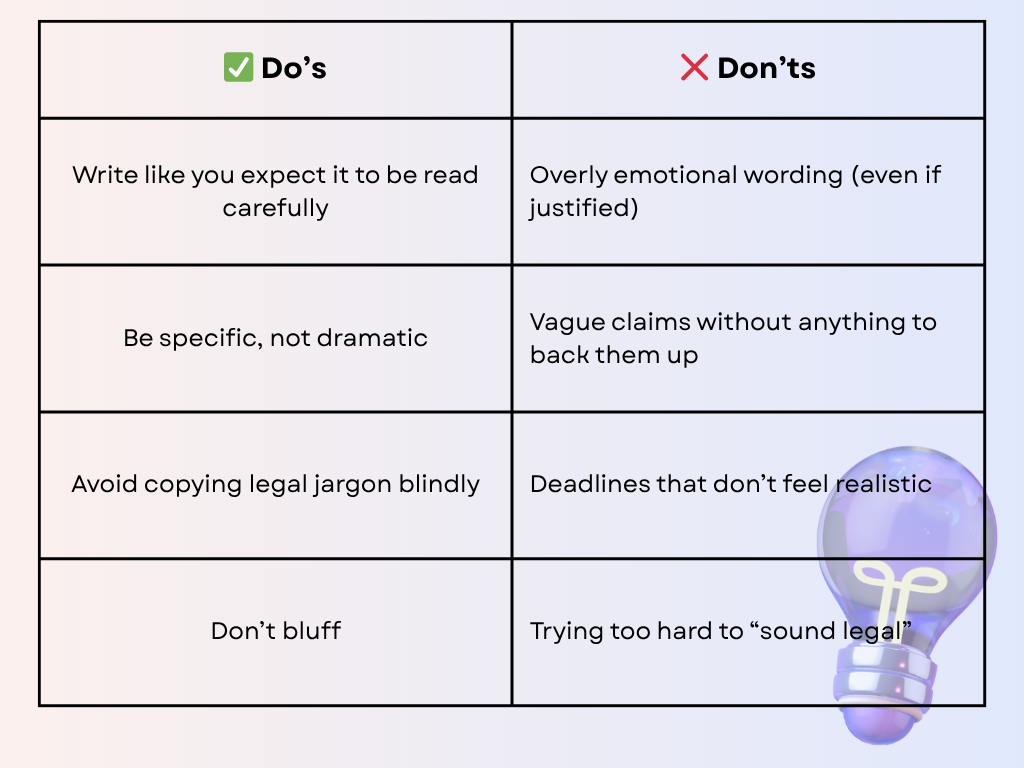
But structure alone isn’t what makes it work. Tone does a lot of the heavy lifting. Here is a few do’s and don’ts.
What Happens Next After the Order?
It depends.
- Sometimes the person just complies and that’s the end of it.
- Sometimes they respond, and it turns into a short negotiation.
- Sometimes nothing happens.
At that point, you decide whether it’s worth pushing further. Not every situation is.
Do you actually need a lawyer?
Not always. A lot of people handle these on their own, especially for straightforward issues.
That said, there’s a noticeable difference between something that’s technically correct and something that’s convincing. If the stakes are higher, legal input helps. If not, having a solid structure to work from is usually enough.
Here is A simpler Way to Draft One
If you’ve ever tried writing one from scratch, you’ll know it’s not the easiest thing to get right.
That’s where tools like DocLegal.AI come in—not to replace judgment, but to give you a reliable starting point. Instead of figuring out structure and wording at the same time, you’re mostly focusing on the facts of your situation.
It’s especially useful if:
- You deal with similar issues more than once
- You want consistency across documents
- You don’t want to second-guess formatting or structure.
If you’d rather not start from zero, you can use this. Just don’t treat it as plug-and-play. The effectiveness comes from how well it reflects your specific situation.
Final thought
A cease and desist letter isn’t about winning a case. It’s about changing the direction of a situation early—before it becomes something bigger. Sometimes that’s enough. Sometimes it isn’t. But when it works, it saves a lot more than just time.



.jpg)