
Facing Harassment? Step-by-Step Guide to Draft a Cease-and-Desist Letter
A cease-and-desist letter is not legally binding and cannot force anyone to stop. However, it creates a paper trail that can support later court action (such as a temporary restraining order or injunction) or police reports. Please see here for a detailed explanation of what a cease-and-desist letter is, and how it is different from a cease-and-desist order.
For serious, ongoing, or threatening harassment, contact your local police department immediately and/or seek urgent advice from a qualified attorney licensed in your state. However, if you just want to formally tell someone to do something, a cease-and-desist letter may help. Sending a letter could escalate the situation, so pay attention to document everything.
Before going into details of what needs to be included in such letter, here is a straightforward template you may use:
Sample Cease-and-Desist Letter for Harassment (U.S.–Friendly Template)
Note: Copy, paste, and customize the placeholders in bold brackets. Use specific dates, times, locations, and descriptions of the behaviour. Send it by certified mail with return receipt requested (or through a process server/solicitor for stronger evidentiary value). Keep copies of everything.
------------------------------------------------------------
[Your Full Name]
[Your Street Address]
[City, State, ZIP Code]
[Your Email Address]
[Your Phone Number]
[Date – e.g., March 31, 2026]
[Harasser’s Full Name]
[Harasser’s Street Address]
[City, State, ZIP Code]
Re: Formal Demand to Cease and Desist – Harassment
Dear [Harasser’s Full Name],
I am writing to you as a formal notice demanding that you immediately cease and desist from all harassing, intimidating, unwanted, or threatening conduct directed at me or anyone connected to me.
Your actions include, but are not limited to, the following:
• On [date], at [location or via method, e.g., “via text message” or “outside my residence at …”], you [describe the specific act in detail, e.g., “sent 15 unsolicited and abusive messages containing personal attacks”].
• On [date], you [further specific incident].
• [Continue listing every relevant incident with dates, times, locations, and evidence (e.g., screenshots, call logs, timestamps, witness statements)].
This repeated course of conduct has caused me significant emotional distress, anxiety, fear for my safety, and [any other specific harm, e.g., “interference with my work and daily life”].
Such behaviour constitutes harassment under the common law and/or statutes of the State of [Your State], and may also violate other applicable laws (including, where relevant, federal wire or electronic communications statutes).
I therefore demand that you immediately:
1. Cease all communication or contact with me by any means whatsoever (telephone, email, messaging apps, social media, in person, through third parties, or otherwise).
2. Cease any form of surveillance, following, approaching, or monitoring of me, my family, friends, or workplace.
3. Remove and delete any harassing, defamatory, or unwanted content you have posted or shared online or elsewhere.
4. Refrain from any further acts that could reasonably be perceived as harassing, intimidating, or unwelcome.
You must confirm in writing within 14 days of receipt of this letter that you have fully complied with these demands and will not engage in any similar conduct in the future.
Please be advised that if you fail to comply, I will have no hesitation in pursuing all available legal remedies, including (without limitation):
• Applying to the courts in [Your State] for a temporary restraining order or injunction to restrain your conduct;
• Commencing civil proceedings against you for damages and other relief for harassment and/or intentional infliction of emotional distress; and/or
• Reporting the matter to local law enforcement or other appropriate authorities for any criminal offences that may have been committed.
This letter is sent without prejudice to any of my rights and remedies and is intended to serve as formal notice. A copy of this letter together with proof of delivery will be retained as evidence.
Yours faithfully,
[Your Full Name]
------------------------------------------------------------
How will the Cease-and-Desist Letter for Harassment Help?
Sadly, in the United States (and most other common law jurisdictions), there is no single nationwide “harassment law.” Instead, protections are a mix of state civil torts (like harassment or intentional infliction of emotional distress) and criminal statutes that vary widely from state to state. But you do have options. Sending a cease-and-desist letter, of course, is one of the simplest and most effective first steps.
It’s not magic, and it’s not a court order. But it often works because it puts the harasser on official notice, creates evidence for later legal action, and shows you’re serious without immediately running to court.
When should you send the Letter?
To send a cease-and-desist letter for harassment, you must first be sure that there is a case of harassment. Although this should be pretty evident when you face such a situation, it is always better to make the basis clear.
In the US, laws differ by state, but courts generally look at whether the conduct is repeated, unwanted, and causes substantial emotional distress or fear.
Common examples include:
- Repeated unwanted calls, texts, emails, or social-media messages
- Showing up uninvited at your home or workplace
- Doxxing or publishing your personal information to cause harm
- Stalking, following, or surveillance
- Threats or defamatory online posts
Many states also have specific anti-stalking or cyber-harassment laws. If the behaviour crosses state lines or involves electronic communications, federal laws (such as the Violence Against Women Act or wiretap statutes) may apply.
Does Strongly-Worded Cease-and-Desist Letter Always Help?
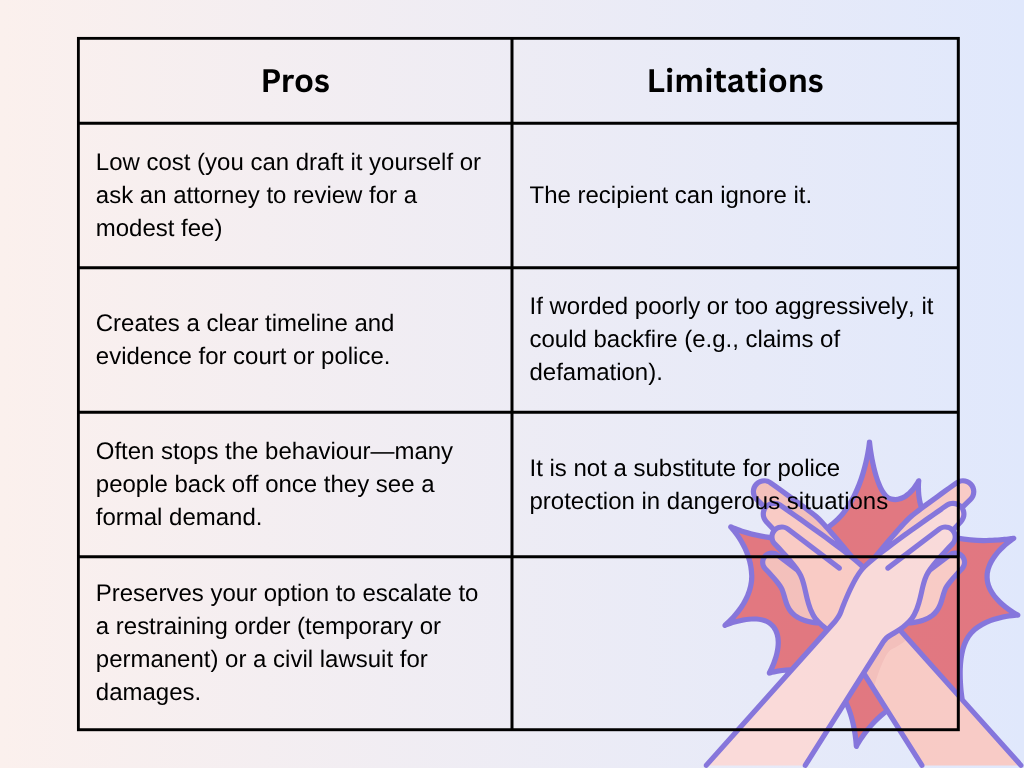
It depends on the context, but generally, no. In fact, sending a cease-and-desist letter may not always be the best option. Here is a comparison of the pros and cons of sending such letter:
What If They Don't Respond to the Cease-and-Desist Letter?
Except from patiently waiting for the other side to respond, if they totally ignored the letter and continued the harassment, there are three other things you can do:
- Report to Police: for any criminal elements (many states treat repeated harassment as a misdemeanor or felony).
- Obtain Restraining Order / Injunction: file for a temporary restraining order (TRO) in your local court—often granted quickly in clear cases.
- Establish Civil claim: sue for damages (emotional distress, lost wages, attorney fees, etc.).
It should be noted that a well-drafted cease-and-desist letter becomes powerful evidence that you tried to resolve the matter reasonably first.
To Re-Cap: What should you do?
A cease-and-desist letter is a powerful, low-conflict tool, but it’s only the first step. If you’re dealing with harassment right now:
- Gather evidence — screenshots, call logs, timestamps, witness statements.
- Write and send cease-and-desist letter:
- Keep it factual and professional — never threaten violence or use insults.
- Be specific — vague letters are easy to dismiss.
- Send proofably — certified mail with return receipt or via an attorney/process server.
- Keep records — save everything.
- Follow up — if ignored, consult an attorney about next steps.
Harassment is never okay. Taking calm, documented action is often the fastest way to make it stop. For immediate safety concerns, call 911 or your local non-emergency police line. Resources like the National Domestic Violence Hotline (1-800-799-7233) or cyberstalking hotlines are also available nationwide.



.jpg)
.jpg)