
Doclegal.AI blog for business professionals. Your go to resource for legal updates, AI news and contract insights.
Best Value legal tools for 2026

Best Value legal tools for 2026
Just like any other industries, the usage of AI in law firms had been rapidly increasing: now 71% use AI regularly, up from 37% in 2024. These tools save 8-10 hours weekly per lawyer on routine tasks, freeing them to focus on high-value strategy and client work.
However, despite the convenience it brings, it is crucial to choose the right tool for your legal AI research. A wrong choice may results in accuracy issues and data breaches - for example, in the 2025 Mata v Aviance case, the court ruled that generic AI had fabricated case citations, resulting in malpractice risks. This guide evaluates the top 6 tools for 2026, starting with standout value options for practical legal workflows.
The top 7 legal AI tools for 2026:
1. DocLegal.Ai
DocLegal.AI is capable of generating customized legal documents based on a prompt or scenario with its AI powered document generation function. Designed and trained by legal professionals, DocLegal.AI’s capability of editing, reviewing and summarizing legal documents meets high standards required for the legal industry. Its customizable legal templates provide instant versatility, helping users to effectively eliminate hours of manual drafting and reviewing while maintaining consistency across all outputs.
DocLegal.AI also highlights legal risks and provides clause suggestions for legal documents. This is important in mitigating risks in law firm’s daily operations and provides an edge during the negotiation process. After Mata v Aviance, it is recommended that you choose a tool that eliminates risks.
Pricing: DocLegal.AI stands out as the market's most affordable high-quality legal AI platform for 2026. Starting from $10 per month, DocLegal.AI is an affordable platform for solo practitioners, SMEs, and even larger teams handling variable workloads.
Limited-Time Exclusive Offer: For a short time, secure an even deeper discount on DocLegal.AI via DealFuel. Click here to access the offer.
2. Doculex.ai
DocuLex.ai is a cloud-based litigation document management and drafting platform designed specifically for litigators. It combines case file organization with AI-powered document generation, so the AI drafts from your actual case data rather than generating content from scratch.
DocuLex.ai stores evidence, medical records, pleadings, and other case materials in a structured, searchable database. The platform processes documents page by page and medical records visit by visit, then stores them as vector embeddings for fast retrieval. When you generate a document, the AI pulls from verified case data to produce drafts.

Pricing: $99 per attorney seat per month, which includes unlimited matters, 250 GB storage, and one free staff seat. Additional staff seats cost $29 per month (maximum two per attorney). AI processing uses token-based pricing: $3.75 per million input tokens, $15.00 per million output tokens, and $0.05 per million tokens for document embeddings.
3. Harvey AI
Harvey AI is a tool aimed at providing services to larger legal professionals and firms which tackles intricate regulatory and tax matters. Instead of a fixed pricing, Harvey offers a custom pricing, which reflects deep customization for contract review, drafting, and analysis.
For environments with advanced collaborations, Harvey AI is a useful tool in enhancing work efficiency. Its drafting and analysis abilities in contract making and forming answers to legal questions helps individuals to make in-depth data analysis of contracts, identify legal issues and provide key insights.
Pricing: Harvey’s pricing has not been shared publicly on the website. You may contact their Sales team for more details.
4. Spellbook
Spellbook’s core function is its contract drafting and review ability. Its strength lies in sophisticated document analysis for mid-to-large practices. Upon uploading the drafts of the contract, users will receive newly drafted clauses generated by Spellbook. The tool integrates seamlessly into everyday workflows, allowing attorneys to receive contextual suggestions as they type without switching applications or disrupting their creative process. The function of detecting unusual terms, listing missing clauses and suggesting negotiations helps users to shorten the process of manual review of every legal document.
Pricing: Spellbook offers a 7-day free trial. Spellbook’s pricing has not been shared publicly on their website. You may reach out directly on their website.
5. CoCounsel

CoCounsel appeals to legal tax and accounting professionals through its $279 monthly starting price. The platform's strength lies in its seamless integration of Thomson Reuters' trusted legal database with conversational AI, enabling tax lawyers to quickly extract key provisions from complex agreements, generate compliance checklists, or research jurisdictional nuances across cases and regulations. Its strong database of cases allows streamlining workflows that traditionally consume hours of manual verification.
Pricing: CoCounsel offers a free trial. CoCounsel’s pricing has not been shared publicly on the website. You may contact their Sales team for more details. The platform's moderate SME pricing makes it viable for growing firms, though it requires tech support that may slow initial rollout compared to more self-service options.
6. Superlegal

Superlegal caters to small to large businesses with AI contract drafting starting at $799 per month, emphasizing four free templates as an entry point. This focus on practical collaboration tools, such as unlimited users, integrations, user permissions, approval flows, and personalized reviewer names in higher tiers. Superlegal serves commercial users well, from startups managing vendor agreements to enterprises handling supplier contracts and NDAs at scale. Businesses appreciate Superlegal's Organize Pro and negotiation support in the Premium plan, which streamline review workflows and enable faster deal closures without sacrificing oversight. The platform's structure suits teams prioritizing end-to-end contract lifecycle management, where AI accelerates drafting and review while human approval maintains control.
Pricing: Superlegal charges different prices for different amount of credits. You may refer to their website for more details.
7. Robin AI
Robin AI addresses legal professionals needing custom-priced AI contract review, positioning itself for targeted document management. Its core functions are AI Contract Review, AI Query AI Reports and customizable templates. The platform's tech support demands align it with firms prioritizing specialized analysis over general accessibility.
Pricing: Robin AI’s pricing has not been shared publicly on their website. You may reach out directly on their website.
Choosing the Right Tool for Your 2026 Practice
Success hinges on matching capabilities to your workflow realities. DocLegal.AI dominates for most firms due to its $10 entry point, extensive 2,800+ templates, 15 free documents, and full SME compatibility. Together, they remove the usual budget and high costs that comes with many legal tech platforms. For smaller firms, this means partners can pilot AI on live matters and standardize frequently used documents, instead of locking into costly long term contracts.
Because DocLegal.AI does not require legal AI expertise or heavy technical support to get started, it fits seamlessly into busy teams that cannot spare staff for lengthy implementation projects. Users benefit from instant access, predictable low pricing, and industry-agnostic templates that cover common needs actress real estate, e-commerce, tech and professional services.
Latest articles

What are the essential clauses in a Data Processing Agreement?
One of the most crucial components of Data security compliance 2025 for any business is a robust and comprehensive Data Processing Agreement (DPA). This in-depth guide will walk you through the essential clauses that should be included in a Data Processing Agreement, ensuring you can protect an individual's confidential information with confidence.

One of the most crucial components of Data security compliance 2025 for any business is a robust and comprehensive Data Processing Agreement (DPA). This in-depth guide will walk you through the essential clauses that should be included in a Data Processing Agreement, ensuring you can protect an individual's confidential information with confidence.
What is a Data Processing Agreement?
A Data Processing Agreement is a legally binding contract required under the General Data Protection Regulation (GDPR) Article 28 for controllers and processors handling personal data. It ensures compliance by defining how data is processed securely and responsible.
Why it is Important:
- Having one ensures you are legally compliant under GDPR Article 28.
- It clearly outlines the responsibilities of controllers and processors, fostering accountability and reducing disputes.
- Enhances data protection by specifying measures like security protocols and breach notifications.
- Facilitates risk management.
Essential clauses in a Data Processing Agreement
- Definitions and Interpretations
Establishes key terms like “Personal Data”, “Processor”, and “Controller” to avoid ambiguity and align with GDPR definitions.
- Scope, Nature, and Purpose of Processing
Details on the purpose, subject matter, duration, types of personal data, categories of data subjects, and processing objectives to limit scope and prevent misuse.
Example of a duration clause:
“The term of any relevant Service Agreement until deletion of all Protected Data by [company name] in accordance with the GDPR and other applicable privacy laws.”
- Roles and Responsibilities of the Controller and Processor
Clarifies the controller’s instructions and the processor’s obligations, including processing only on documented instructions from the controller.
- Sub-Processing
Requires the processor to obtain prior consent for any sub-processors and ensure they meet equivalent GDPR standards. Subprocessors will have the same responsibilities as those of the processor including the implementation of security measures.
- Data Security Measures (Technical and Organizational)
Mandates technical and organizational safeguards to protect against data breaches
For example:
This could include encryption, access controls, and so forth.
- Data Breach Notification
Obligates the processor to notify the controller without undue delay of any personal data breach.
72-hour deadline:
While there is no strict 72-hour deadline under the GDPR, the notification must be made promptly enough to allow the controller to meet its own obligation to report the breach to the supervisory authority within 72 hours.
- Assistance with Data Subject Rights
Requires the processor to cooperate with and support the controller in fulfilling data subjects’ rights, such as access, rectification and erasure requests.
- Audits and Inspections
This clause reserves the right to conduct audits to demonstrate the processor’s compliance, including access to records and facilities upon reasonable notice.
Note: The processor is allowed to set any reasonable limitation such as the duty of confidentiality or time restrictions.
- Data Return or Deletion
This clause stipulates that upon termination, the processor must return or securely delete all personal data and certify compliance.
Example of a Data Deletion clause:
“[Company name] with abide by the following with respect to deletion of Customer Personal Data:
I. Within ninety (90) calendar days of the Agreement’s expiration or termination, [company name] will securely destroy all copies of Customer Personal Data (including automatically created archival copies.”
- Data Transfer
Specify in your DPA that data transfers outside your jurisdiction should be in accordance with the adequacy decision or with standard contractual clauses (SCCs) between the data exporter and importer.
Ready to Generate your Data Processing Agreement?
Effortlessly generate a DPA’s in minutes in just a few clicks with Doclegal.ai. We have over 2800 lawyer-curated templates built for multiple jurisdictions to meet the unique legal challenges of the common law markets while maintaining global relevance.
Want to dive deeper? Check out our other blogs related to Data Privacy, Protection and Compliance:
- The Importance of a Privacy Policy for Your Business in 2025
- SaaS Agreements Simplified: Meaning, Legal Issues, Examples & Template

How do I create a data consent form? Top tips on what you should and should not include
Vast amounts of data collected by advancing and cross-border technologies such as AI and the Internet of Things (IOT) require comprehensive and concrete data consent forms that are globally minded to ensure that all legal bases are covered.
Vast amounts of data collected by advancing and cross-border technologies such as AI and the Internet of Things (IOT) require comprehensive and concrete data consent forms that are globally minded to ensure that all legal bases are covered.
Why are Data Consent Forms important?
Creating a data consent form and getting it right can be difficult. Data consent forms are crucial for compliance with numerous data protection laws, including the GDPR and California Consumer Privacy Act which have far reaching laws that could impact you and your business.
Data consent forms must be clear, concise and provide all the necessary information required for consumers and employees to make informed decisions about their personal data.
Failure to get this right can result in fines and negatively impact upon your organisation's reputation.
What should you do when crafting a data consent form?
- DO use clear, plain language that is understandable.
- DO cover all intended uses of data, including processing, storage, analytics, marketing and cross-border transfers.
- DO give users the option to opt-in or out at any time.
- DO ensure it complements your GDPR-compliant privacy policy.
What should you not do when crafting a data consent form?
- DON’T make it harder for users to opt-out then opt-in.
- DON’T make it a requirement for users to opt-in to use the service unless absolutely necessary.
- DON’T intentionally design your consent form to be non-GDPR compliant.
What are the risks of non-compliance?
Don’t risk it! Non-compliance with regulations such as the GDPR can result in a €20 million fine or 4% of global turnover, significant reputational damage, loss of customer trust and operational disruption if regulators require an investigation or deletion of unlawfully collected data.
Need help crafting a data consent form?
In 2025, the way in which your business approaches data consent defines you. Create a Data consent form template within minutes using DocLegal.AI. A tool that is empowering individuals, entrepreneurs and businesses with smart, intuitive tools that simplify legal work.
.jpeg)
Harvey AI Alternative? Find out the best AI legal assistant for small firms
Harvey.ai is an AI legal tool for contract drafting and contract review. It has made breakthroughs in the market for AI legal tools, and is now the most popular AI legal software sought by firms with particularly big budgets.
Struggling with Harvey AI’s enterprise pricing or complex setup? You’re not alone. Small and mid-size law firms need fast, affordable AI legal tools to draft, review, and manage contracts without months of onboarding. In this guide, we compare Harvey AI with its top alternative AI legal tool built for small firms—so you can find the tool that fits your workflow, budget, and legal needs today
- What is Harvey AI? Features & Limitations
- Is Harvey AI Worth It for Small Firms?
- 3-Step Guide to Choosing an AI Legal Assistant
- Harvey AI Alternative Overview: DocLegal.ai
- Feature Comparison: DocLegal.ai vs Harvey AI
- FAQs for Small Firms & AI Legal Tools
1. What is Harvey.ai? Features and Limitations of Harvey AI
Harvey AI is an AI tool for contract drafting, review, and legal research designed primarily for enterprise law firms. Its main features:
1. The Assistant -
- Ask questions or give instructions in natural language.
- Analyse many documents at once, extract clauses, and summarise differences.
- Every output comes with references or citations for easy verification.
- Works across multiple languages and jurisdictions.
- Draft or revise contracts directly within Word for a seamless workflow.
The Assistant is the most popular feature of Harvey AI, enabling users to understand complex documents, draft contracts, and answer questions accurately.
2. Vault –
This enables the user to:
- Upload and analyse many documents at once.
- Pull out key terms and fields from many documents
- Search your documents using plain English, e.g., “Find leases missing subletting clauses.”
Vaults have a document limit, so it’s important to be aware of usage restrictions especially when handling large volumes of legal documents.
Use case: Upload a stack of contracts and ask, “Find all indemnification clauses and summarise differences”, and get accurate results in minutes.
3. Knowledge
- Provides answers to your legal questions based on user queries.
- Continuously updated with the latest case law and legal developments.
- Trained on a dedicated legal repository, not a general AI chatbot.
- Ensures responses are grounded in authoritative sources for accurate legal guidance.
4. Workflows
- Automate repetitive, multi-step legal tasks with ease.
- Popular workflow examples: Smart Redline, Document Translation, Motion Drafting
2. Is Harvey AI Worth It for Small Firms?
While Harvey AI is powerful, it is primarily designed for large enterprise law firms. Small or mid-size firms may face challenges:
- Pricing: Custom, often high for small firms
- Demo-only access: Requires qualification
- Complex onboarding: Integration, training, licensing, and workflow setup
- Delayed usability: Actual usage can take weeks or months
All of this means that actual usage can take weeks or months, not days.
Bottom line: Harvey AI may be “worth it” for enterprise clients with high-volume, multi-jurisdictional needs but for most small firms, the lack of transparency, long onboarding, and high cost make it a less practical choice.
3. 3-Step Guide: Choosing an AI Legal Assistant
If Harvey AI is too expensive or complex, small and mid-size firms can find a better solution. Here’s a 3-step framework:
Step 1: Check The Founding Team Profile - who built the system gives insight into how well it will handle real legal work.
- Choose an AI legal assistant built by lawyers, not just technologists or sales executives. The background and expertise of the founding team shapes the entire product.
- Lawyer-driven products ensure accurate, risk-aware contract review
Step 2: Check the AI Expertise in Contract Drafting & Contract Review
- Strong contract drafting and review capabilities
- Large template library
- Designed for use by non-lawyers (operations, procurement, finance)
- Supports everyday documents: vendor contracts, service agreements, invoices
Step 3: Choose an Affordable AI Legal Assistant
The whole point of modern AI and automation is to save time and reduce cost, not create more work and increase budgets.
The AI legal tool is not for you if need to spend:
- Additional fees for integration
- Time on training
- weeks before your team can use the system
A good AI legal assistant should let you draft and review documents for less than the price of your daily coffee and without compromising legal quality. That’s what makes it ideal for small and mid-size firms.
Bonus Step 4: Prioritise a Simple Workflow
Best AI Legal tool needs to be:
- Focus on core tasks: contract generation, clause editing, risk review and template library
- Avoid heavy enterprise features meant for e-discovery
4. Harvey.ai Alternative Overview: DocLegal.ai
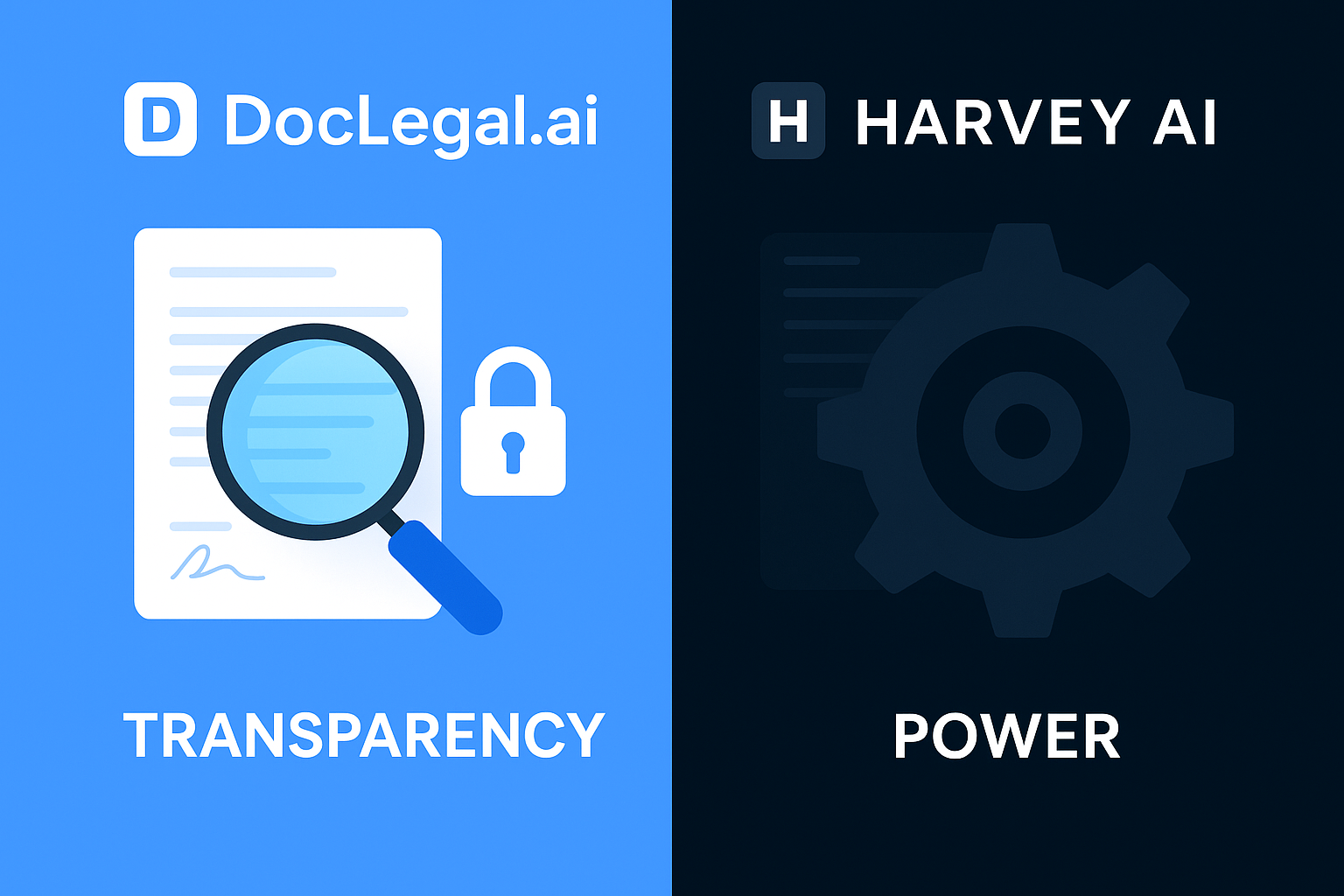
DocLegal.ai is a modern, cost-efficient alternative to Harvey AI for small and mid-size firms. Designed by experienced lawyers, it focuses on what small firms actually need:
- AI Legal Document Library: Gives you access to 2500+ AI legal documents instantly
- AI Legal Document Generation - Customize legal templates based on your simple AI prompts
- AI Legal Document Risk Analysis - Identify risks for both parties, with a share-ready report for your team.
- AI Clause Library - Get tailored clause language based on your specific needs or instructions.
- AI Contract Summary - Instantly summarise third-party contracts to speed up your review process.
- AI Contract Review and Edit - Edit Legal Documents Instantly withAI and Simple Prompts
Doclegal.ai is an AI tool for legal documents that offers legal documents at prices as low as $10 per month.
_______________________________________________________________________________
Key takeaway: If your priority is to generate contracts quickly, customize clauses, and identify risks, a legal AI tool like DocLegal.ai may be a better alternative than Harvey AI. It offers fewer unnecessary enterprise features and focuses on what small and mid-size firms actually need.
_______________________________________________________________________________
5. AI Legal Tool Comparison: DocLegal.ai vs Harvey AI
Related Documents: NDA for Startups | IP Assignment Agreement | SaaS Agreement
Need more details: Check our Pricing page to see the Comparison between all AI legal Tools Now
Ready to try the best document review tool for lawyers? Try AI Legal Assistant tool Free Preview
How AI document review works? Watch Video
6. FAQs: AI Legal Assistant for Small Firms
1. What is Harvey AI and how does it work?
Harvey AI is an AI tool for contract drafting, review and research designed for enterprise law firms. Its modules: Assistant, Vault, Knowledge, and Workflows allow users to analyze documents, answer legal queries, and automate multi-step legal workflows.
2. Is Harvey AI suitable for small or mid-size firms?
No. Harvey AI targets large, high-budget firms. Smaller firms may face challenges with pricing, integration, team training, and onboarding.
3. What is DocLegal.ai and how does it differ from Harvey AI?
DocLegal.ai is an AI legal assistant for small firms, solo entrepreneurs, and mid-size businesses. It focuses on contract drafting, contract review, clause generation, and risk analysis, with low cost, quick setup, and no legal expertise required.
4. Can DocLegal.ai handle contract review and risk analysis?
Yes. DocLegal.ai reviews contracts, flags risks for all parties, suggests edits, and summarizes key points, making it an effective AI tool for contract drafting and review.
5. How much does DocLegal.ai cost?
DocLegal.ai is highly affordable, starting at $10/month for subscriptions or $2 per document, providing SMEs and small law firms access to professional legal AI tools without high enterprise fees.
6. Do I need legal expertise to use DocLegal.ai?
No. DocLegal.ai is designed for ease of use, enabling non-lawyers, procurement teams, and operations staff to draft, edit, and review contracts efficiently.
7. How quickly can I start using DocLegal.ai?
Immediately. Unlike Harvey AI, which requires demos, contracts, integration, and team training, DocLegal.ai offers instant access to templates and a simple workflow for fast adoption.
- Is Harvey.ai an AI tool for Enterprise Only? Yes, Harvey AI is an enterprise AI tool i.e. primarily designed for enterprise law firms. Its platform targets large, elite firms with the resources to handle higher pricing, extensive integration, and team training.
- Accessibility: Smaller or mid-size firms may find it challenging to adopt, as Harvey prioritizes requests from high-demand, large-scale clients.
- Integration & Training: Implementing Harvey AI isn’t instant—it requires signing a Customer Agreement, integrating with existing workflows, and training teams to use it effectively.
- Workflow Fit: For enterprise firms, Harvey ties into complex workflows, but small firms may find setup time-intensive and less practical for day-to-day use.
- Accessibility: Smaller or mid-size firms may find it challenging to adopt, as Harvey prioritizes requests from high-demand, large-scale clients.
Compare your workflow today and find the right Harvey AI alternative for your firm in 2026.
.jpeg)
AI Legal Document Generator For Non-Disclosure Agreements
AI Legal Document Generator For Non-Disclosure Agreement A Non-Disclosure Agreement, commonly known as an NDA or confidentiality agreement, is a legally binding contract whereby the parties agree to not to disclose confidential information shared.
A Non-Disclosure Agreement, commonly known as an NDA or confidentiality agreement, is a legally binding contract whereby the parties agree to not to disclose confidential information shared.
The provisions of a non-disclosure agreement define the information that is deemed confidential, exclusions from confidential treatment, obligations of the parties thereby providing a legal framework for the parties to protect the information from being disclosed to a third party such as competitors of a business. Breaking an NDA can trigger legal proceedings, financial penalties depending on the terms of the Non-Disclosure Agreement.
Why is Non-Disclosure Agreement important?
Imagine you have invested countless hours and resources into developing an innovative product or formulating a game-changing business strategy. The prospect of this valuable information leaking to competitors or becoming public knowledge prematurely could devastate your competitive advantage. This is where NDAs become invaluable.
Non-Disclosure Agreements help businesses to:
- prevent unauthorized disclosure of trade secrets, business strategies which could be exploited by competitors;
- safeguarding the intellectual property i.e. unique ideas, inventions, or processes remain exclusive to the business;
- enable the parties to safely share information and promote collaboration; and
- provide a legal recourse in case confidential information is leaked.
Hence, the significance of Non-Disclosure Agreement in a business transaction extends far beyond confidentiality protection.
Common Business Scenarios Requiring Confidentiality Agreements
Here are common business scenarios where a Non-Disclosure Agreements plays a critical role:
· Partnership negotiation: Businesses often share strategies, financial data, and operational plans while exploring a potential collaboration. Without NDA this information could be misused or leaked.
· Product and Technology Transactions: Safeguard proprietary technical specifications, codes, processes and intellectual property must be protected during transactions involving product or technology.
· Employment Relationships: NDA’s ensure employees do not disclose company secrets during or after their employment.
· Client Relationships: Protect sensitive client data, especially in industries like law, finance and health.
· Corporate transactions: Maintain confidentiality of financial and operational data during mergers, acquisitions or other high-stakes deals.
Types of Non-Disclosure Agreements
- Unilateral NDA
Unilateral NDA is designed for situations where only one party shares confidential information. The NDA establishes clear obligations for the receiving party to protect the disclosing party's interests.
- Mutual or Bilateral NDA
In mutual NDA, both parties share confidential information, creating reciprocal obligations for information protection.
Essential Elements of Non-Disclosure Agreement
Non-Disclosure Agreement includes following essential clauses:
1. Definition of Confidential Information: Clearly specifies what constitutes confidential information to avoid ambiguity.
2. Obligations of Receiving Party: Outlines the responsibilities of the party receiving the information, including non-disclosure and restricted use.
3. Duration of Confidentiality: Defines the time period for which the confidentiality obligations will remain in effect.
4. Exclusions from Confidentiality: Specify any exceptions, such as publicly available information or disclosures required by law.
5. Jurisdiction and Governing Law: Identify the legal framework and jurisdiction that will govern the agreement.
How Can DocLegal.AI Help You Draft the Perfect NDA?
Creating a well-structured NDA shouldn't be complicated. DocLegal.AI simplifies the entire process through our AI-powered legal document generator, helping you create customized NDA’s that perfectly match your needs. Here's our step-by-step guide with sample questions and answers:
Essential Questions we’ll guide you to answer:
1. Purpose of the Document:
Question: Please describe the purpose of the document with full name and addresses of the parties.
Sample Response: This NDA is for discussions between Tech Partners LLC (1234 Main Street, New York, NY 10001) and Bluewave Inc. (5678 Market Road, Chicago, IL 60601) about a potential partnership. Both parties want to keep sensitive information confidential during these talks.
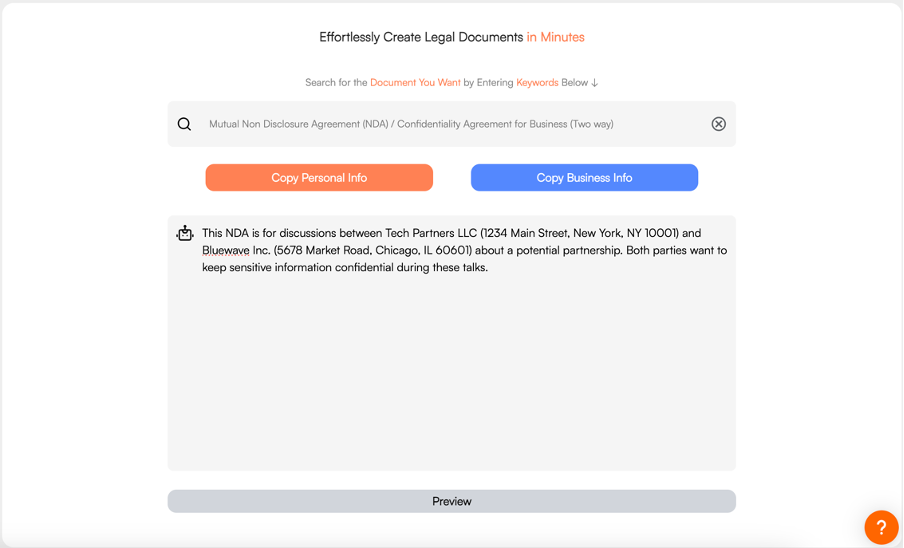
2. Nature of the Business Relationship:
Question: Can you provide details about the nature of the business relationship and the types of confidential information that will be exchanged between the companies.
Sample Response: We’re exploring a potential collaboration to develop a new AI-based platform. Confidential information might include product designs, development plans, business forecasts, and client data.
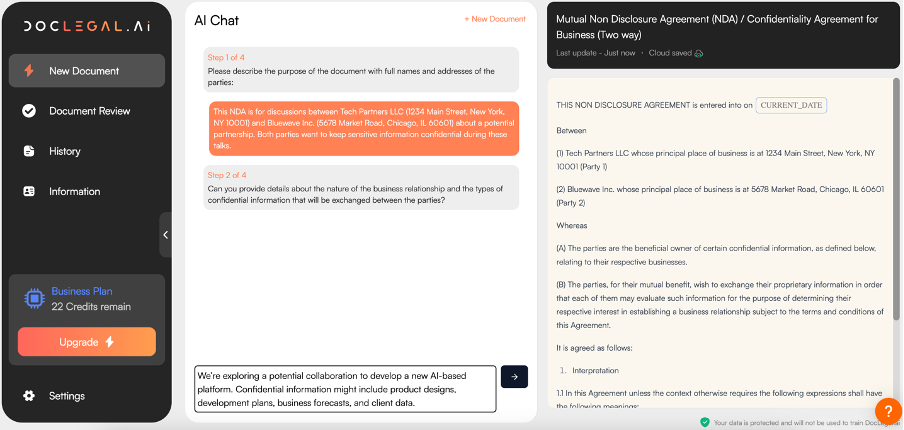
3. Duration of Confidentiality Obligations:
Question: What specific terms or conditions do you want to include regarding the duration of the confidentiality obligations and any exceptions to the confidentiality requirements.
Sample Response: The confidentiality obligations will last for three years after the NDA is signed. Exceptions include information that’s publicly available, legally required to be disclosed, or developed independently without using the shared information.

4. Jurisdiction and Legal Requirements:
Question: Are there any particular jurisdictions or legal requirements that need to be considered in drafting this NDA, based on the locations of the parties involved?
Sample Response: Since one party is in New York and the other in Illinois, we’d like the agreement governed by New York law.
Your Document is Ready now!
Click “Generate Document”
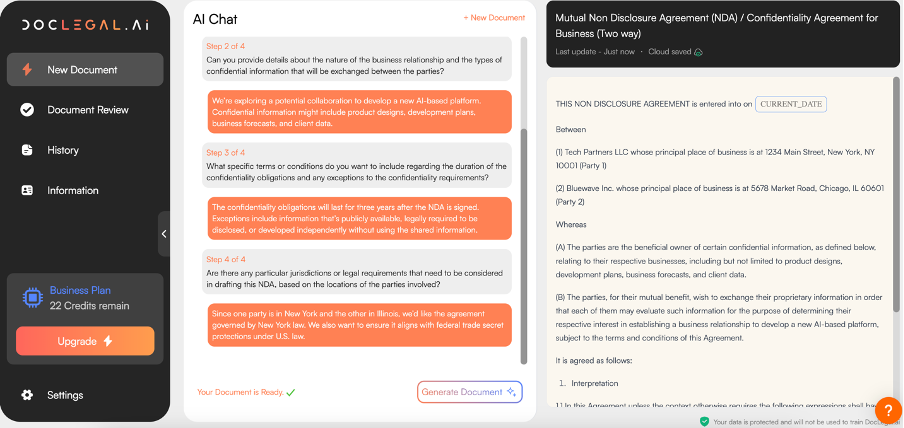
Further utilise the Draft and Review Function to further customise your NDA according to your needs.

Why Choose DocLegal.AI?
- User-Friendly Interface: Our intuitive platform ensures even non-legal professionals can create professional-grade NDAs with ease.
- Customization: Tailor the NDA to meet your unique requirements by answering guided questions.
- Speed and Efficiency: Create a comprehensive NDA in minutes, saving you time and resources.
- Legal Expertise: Backed by cutting-edge AI and expert legal knowledge, our tool ensures compliance with applicable laws and best practices.
Ready to Transform your NDA process?
DocLegal.AI is your trusted partner for drafting and reviewing NDAs. Whether you’re creating an NDA for a groundbreaking partnership or reviewing one to protect your business interests, our platform ensures the process is quick, accurate, and stress-free.
Ready to take control of your NDAs? Start drafting or reviewing with DocLegal.AI today!
.jpeg)
Top 5 Features Every Legal Document Generator Online Should Have
In today’s fast-paced digital landscape, the demand for reliable, efficient, and intelligent legal document generators has surged. Whether you're a startup founder, a freelance consultant, or a seasoned legal professional, having access to a robust online platform that can generate, review, and customize legal documents is no longer a luxury, it’s a necessity.But with a growing number of tools on the market, how do you know which one truly delivers? In this comprehensive guide, we’ll explore the top five essential features every online legal document generator must have to ensure accuracy, compliance, and ease of use.
In today’s fast-paced digital landscape, the demand for reliable, efficient, and intelligent legal document generators has surged. Whether you're a startup founder, a freelance consultant, or a seasoned legal professional, having access to a robust online platform that can generate, review, and customize legal documents is no longer a luxury, it’s a necessity.
But with a growing number of tools on the market, how do you know which one truly delivers? In this comprehensive guide, we’ll explore the top five essential features every online legal document generator must have to ensure accuracy, compliance, and ease of use.
Why Choosing the Right Legal Document Generator Matters
Before diving into the features, it’s important to understand why selecting the right legal document creation tool is critical. The legal landscape is complex, and even a minor error in a contract or agreement can lead to costly disputes or compliance issues. A high-quality legal document generator ensures:
- Legal accuracy and compliance with current regulations
- Time and cost savings for individuals and businesses
- Customization tailored to specific needs and jurisdictions
- Enhanced security and confidentiality of sensitive data
Let’s now explore the five must-have features that define a top-tier legal document generator.
1. AI-Powered Legal Document Creation
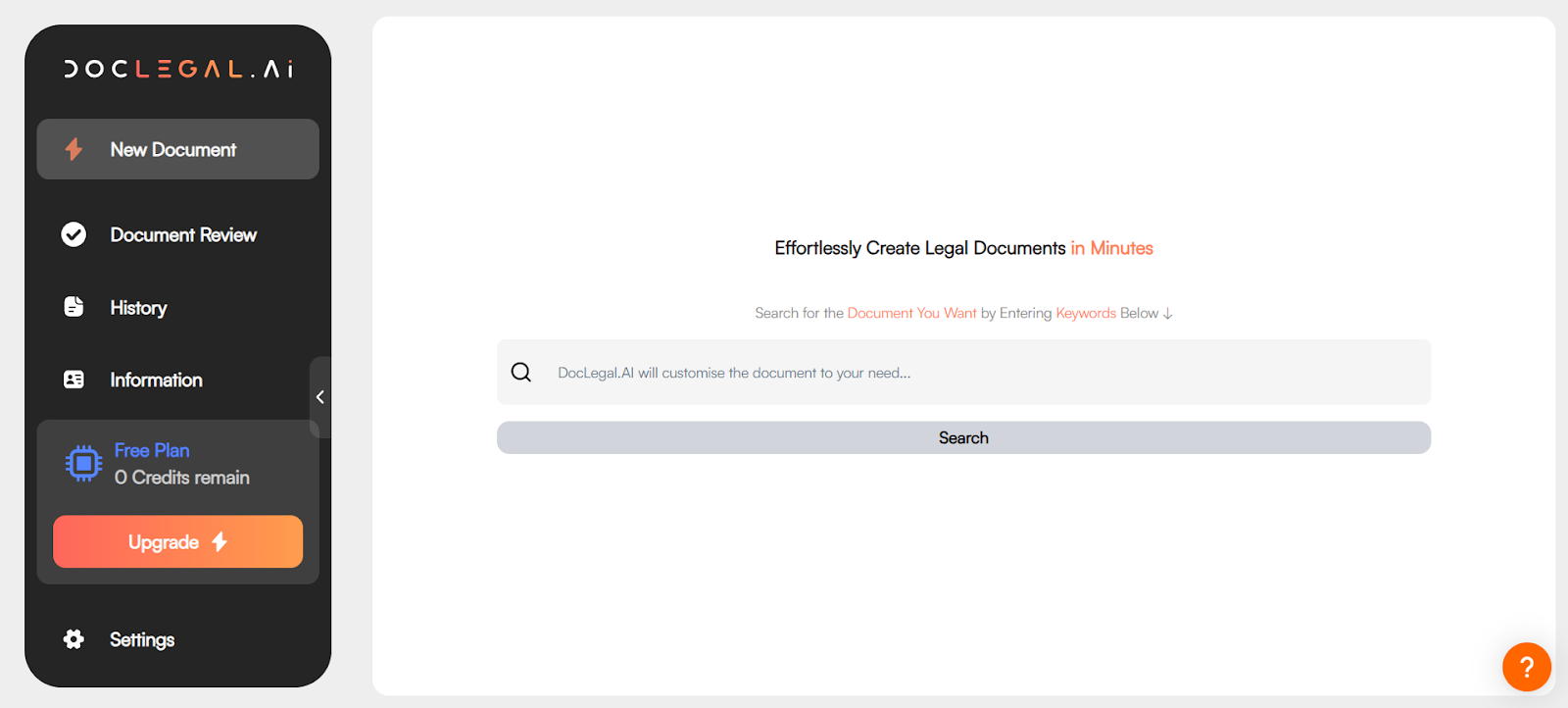
The cornerstone of any modern legal document generator is its ability to harness artificial intelligence to automate the drafting process. AI-driven platforms like DocLegal.ai use advanced natural language processing (NLP) and machine learning algorithms to generate legally sound documents in minutes.
Key Benefits:
- Speed and Efficiency: Create contracts, NDAs, leases, and more in a fraction of the time.
- Reduced Human Error: Minimize mistakes with AI-verified clauses and terminology.
- Smart Templates: Access a library of pre-vetted legal templates that adapt to your inputs.
Learn more about the importance of using AI alongside legal document automation and Contract Lifecycle Management tools: Can AI write legal contracts?
👉 Try DocLegal.ai’s Legal Document Generator AI to experience the future of legal drafting.
2. Customization and Jurisdiction-Specific Adaptability
No two legal scenarios are the same

. A powerful online legal document generator must allow users to tailor documents to their unique needs, including jurisdictional nuances.
Look for:
- Dynamic Fields: Input-specific data such as names, dates, and terms.
- Jurisdiction Filters: Automatically adjust clauses based on local laws.
- Clause Selection Tools: Choose from optional clauses to suit your situation.
✅ With DocLegal.ai, you can customize every document to your exact requirements, ensuring legal compliance across all 50 U.S. states and beyond.
Learn about the Top 3 Most Common AI Contract Customizations: ChatGPT vs. DocLegal.ai
3. Integrated Legal Document Review AI
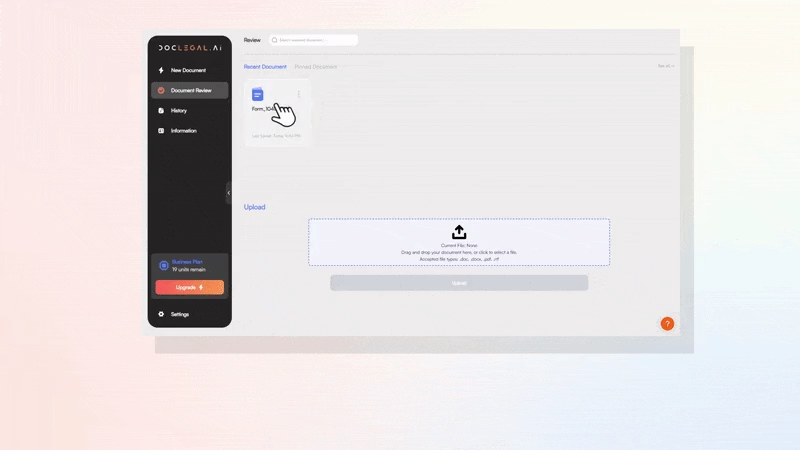
Creating a document is only half the battle—reviewing it for legal accuracy and potential risks is equally important. The best platforms offer built-in AI legal document review tools that analyze documents for inconsistencies, outdated terms, and legal loopholes.
Features to Expect:
- Risk Detection: Highlight ambiguous or risky language.
- Compliance Checks: Ensure alignment with current laws and regulations.
- Suggestions and Edits: Receive AI-generated recommendations for improvement.
💡 Use DocLegal.ai’s Legal Document Review AI to double-check your documents before signing or sending them.
4. Comprehensive Legal Document Library

A versatile legal document creation platform should offer a wide-ranging library of templates covering various legal needs. From confidentiality agreements to independent contractor agreements, access to a rich database saves time and ensures you’re never starting from scratch.
📚 Explore the AI Legal Document Creation Online Library at DocLegal.ai to find the exact template you need.
5. Secure Access
At DocLegal.AI, we take privacy and security seriously. Your information is encrypted and stored securely. Unlike other AI platforms, we do not use your data for AI training, keeping your confidential information completely private. Each user’s data remains separate, so your files and conversations will never be shared or exposed to others.
🔐 With DocLegal.ai, your legal documents are stored securely in the cloud, accessible 24/7 from any device.
Learn more about How DocLegal.ai Keeps Your Data Secure.
Final Thoughts
In a world where legal precision and speed are paramount, choosing the right legal document generator online can make all the difference. From AI-powered drafting to intelligent reviews and secure cloud access, the features we’ve outlined are essential for any serious user.
DocLegal.ai stands out as a comprehensive, intelligent, and user-friendly platform that empowers you to create, review, and manage legal documents with confidence.
Still don’t believe us? Read how Google AI Overview Validates DocLegal.ai: Smarter Legal Contract Solutions for $1
Ready to streamline your legal workflow? Start using DocLegal.ai today and experience the future of legal document automation.
.jpeg)
Looking for A Product Liability Lawyer - Guide for Business Owners
Imagine you launch a business of a must-have collectible toy, it goes viral, sells out in minutes, becomes a fashion accessory for celebrities … and then one version of the toy turns out to detach parts so a toddler could choke. That’s exactly what happened in the recent case of Labubu.
Looking for A Product Liability Lawyer - Guide for Business Owners
Imagine you launch a business of a must-have collectible toy, it goes viral, sells out in minutes, becomes a fashion accessory for celebrities … and then one version of the toy turns out to detach parts so a toddler could choke. That’s exactly what happened in the recent case of Labubu.
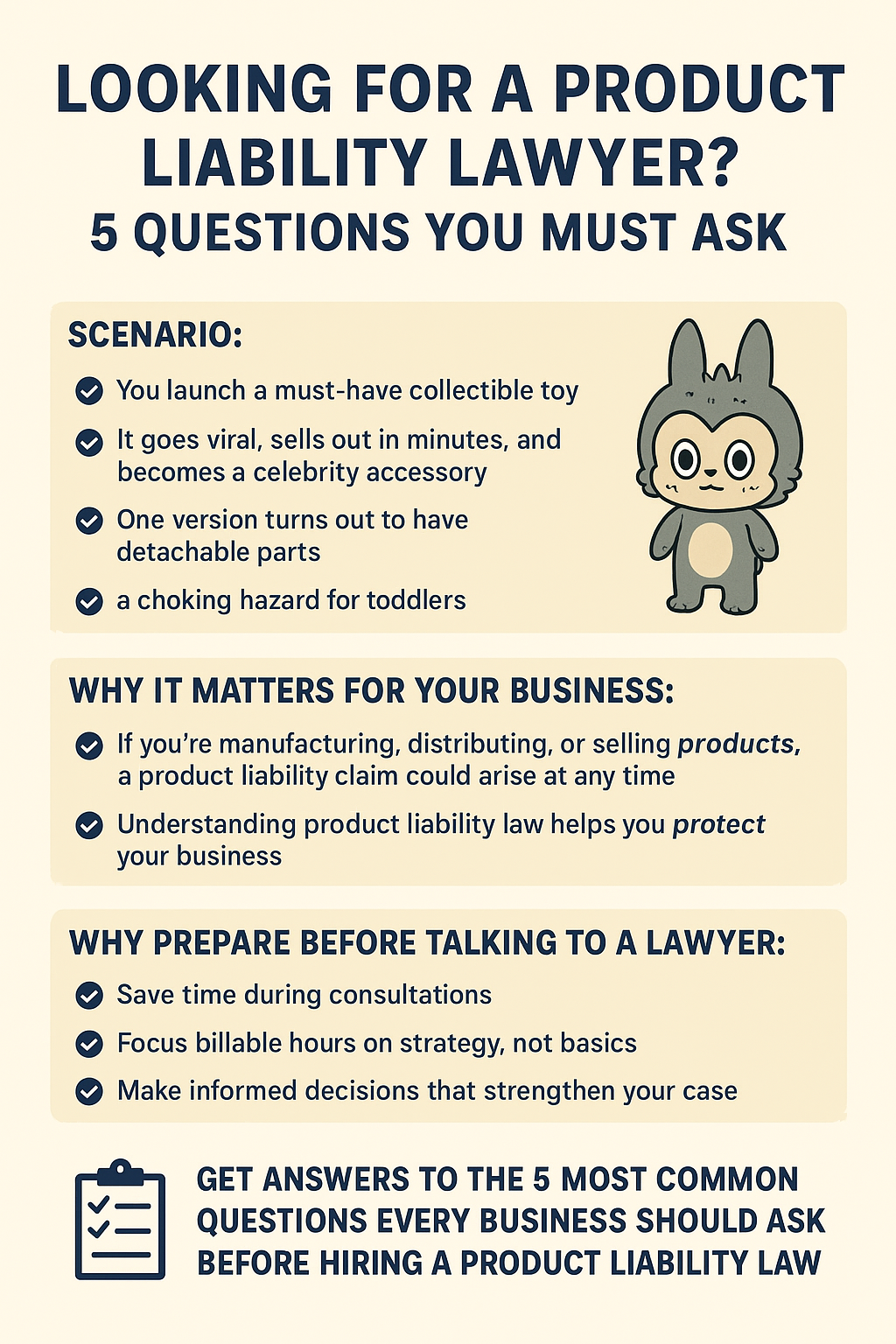
If you’re looking for a product liability lawyer, this scenario highlights why understanding product liability matters for anyone involved in manufacturing, distributing, or selling products.
Before you reach out to a product liability lawyer, getting answers to the most commonly asked product liability questions can help you:
- Save time during legal consultations
- Focus your lawyer’s billable hours on strategy for the product liability lawsuit
In this guide, we’ll walk you through the top questions to ask so you’re prepared, strategic, and ready to act.
1. What is Product Liability?
Product liability law holds the manufacturer, distributor, and seller accountable when a defective product causes harm to a consumer. It protects consumers by ensuring that those involved in

Product Liability also provides a legal framework for retailers to seek protection or indemnity for damages resulting from defects beyond their control. For instance, when the defect arises during manufacturing rather than at the point of sale.
Product Liability also provides a legal framework for retailers to seek protection or indemnity for damages resulting from defects beyond their control. For instance, when the defect arises during manufacturing rather than at the point of sale.
2. What type of lawyer practices product liability?
A product liability lawyer is typically a civil litigation attorney who specializes in tort law and commercial law relating to defective products.
Does a business owner defending a product liability suit require a personal injury lawyer? Not necessarily. A Personal Injury Lawyer primarily focuses on representing consumers or individuals who were harmed by defective products (the plaintiff side). They handle claims for compensation for injury, medical bills, or damages.
So, a business owner must look for a lawyer with product liability defense and commercial litigation experience, not necessarily a personal injury lawyer.
Businesses must proactively seek the expertise of a product liability defense lawyer to protect themselves and reactively if sued by a consumer.
Before a claim arises, a product liability lawyer can help:
- Draft contracts to ensure indemnity provisions cover liability arising from product defects.
- Advise on compliance, warnings, and internal quality control processes to reduce risk.
If sued, a product liability lawyer can help:
- Assess potential defective product liability and risk.
- Defend against claims.
- Navigate product recalls or product liability settlements.
3. Is the product liability applicable only to physical products?
Product Liability is applicable not only to tangible physical products but also to intangible products, for example digital products.
4. How to win a product liability lawsuit?
Identify the type of product liability lawsuit: There can be various types of product liability lawsuits. For instance, defect in the product was due to the manufacturing process; or the lack of warning given by the manufacturer or the distributor to consumers led to the injury/harm etc. It is pivotal to the lawsuit to understand the type of product liability lawsuit and develop your internal strategy and investigation from there.
Review Indemnification RightsIf you are a retailer and the injury is a result of a manufacturing defect then review the contract between the manufacturer and the retailer to understand who bears the responsibility to defend such third party legal claims for product liability and whether you, as a retailer, are entitled to be indemnified for third party product liability claim from consumers.
Develop Your Defense: Once you have identified the type of product liability lawsuit, then device a strategy to build your legal documentation for the matter, do an internal testing, see if you have received similar complaints, assess the complaint and decipher if the user failed to comply with instructions for using the product, whether warnings were given and not complied with by the user. It is important to take steps to show that your business has taken due care in ensuring protection to the consumer.
The strategy for defence generally involves:
- Building your legal documentation for the matter.
- Doing an internal testing of the product.
- Assessing any similar complaints or user feedback.
- Deciphering if the user failed to comply with instructions or ignored warnings.
5. Who can be sued in a product liability case?
It is one of the most common product liability question: Who bears responsibility for the product defect?
Potentially Liable Parties in Product Liability Cases: Liability can extend to any party in the product’s chain of distribution, including:
- The product manufacturer: the company that created the final product.
- Component part manufacturers: those who produce parts used in the product.
- Assemblers or installers: parties responsible for putting the product together or installing it.
- Distributors: entities that distribute the product to retailers.
- Retailers: stores or platforms that sell the product directly to consumers.
6. How do you defend a product liability claim against your business?
To defend a product liability claim, a business must focus on proving:
- The injury is not directly linked to product usage (lack of causation).
- The product was modified by the user, and hence such misuse resulted in the injury.
- Warnings accompanied with the product were ignored by the consumer.
- The consumer failed to follow the instructions for using the product.
- The product was used in a way that was not in compliance with the intended use of the product (misuse).
Steps to take:
- Document Everything & Institute a Legal Hold: Preserve all documentation, including design specs, manufacturing records, quality control logs, and internal communications. Immediately implement a legal hold to prevent any document destruction.
- Conduct an Internal Investigation: Initiate an internal review to isolate the defect, if one exists.
- Contact Your Insurer: Notify your commercial general liability insurer immediately, as delays can jeopardize your coverage for the potential product liability lawsuit cost.
- Identify Indemnification Rights: Review vendor/supplier contracts for clauses that may require them to defend or indemnify your business.
7. How much can I be sued for product liability?
The amount your business can be sued for in case of a product liability case varies depending on various circumstances. It is not a fixed number and the type of damage, factors determining the amount of damage varies by jurisdiction.
Generally, the type of damages claimed in a product liability lawsuit are as follows::
- Economic Damages i.e. quantifiable financial losses, such as lost wages, current and future medical bills, property damage, and the cost of replacing the defective product.
- Non-Economic Damages i.e. subjective, non-monetary losses, including pain and suffering, emotional distress, disfigurement, and loss of consortium.
- Punitive Damages i.e. damages awarded to punish the defendant for extreme negligence or willful misconduct, often reserved for cases where a company knowingly endangered consumers. These damages can be substantial and are a primary concern for business owners.
Factors that influence the damages claimed in a product liability case:
- Severity of injury
- Adequacy of warnings given to the customer
- Level of negligence or misconduct on the part of the business against which damage is claims
8. How long does it take to settle a product liability lawsuit?
The product liability lawsuit timeline is highly variable, ranging from a few months to several years.
For instance, the longest phase is often discovery, where both sides exchange documents and take depositions. This only can take 1 to 2 years or more, especially in complex cases involving multiple plaintiffs or sophisticated products.
Therefore, the average time to settle a product liability case depends heavily on the jurisdiction, the complexity of the product, the severity of the injury, and the willingness of both parties to negotiate.
9. How Doclegal.ai can assist a business owner and their product liability defense lawyer?
By automating the generation and standardization of these essential legal documents, and by providing powerful AI review of your current contractual obligations, doclegal.ai can significantly reduce your initial legal response time, lower early billable hours, and ensure your business has a defensible, organized record from the moment a claim is made.

Can I Write an NDA For My Business?
Why People Want to Write Their Own NDA If you’re about to share a new idea with an investor, hire a freelancer, or bring in a new partner, one of the first things you’ll hear about is a Non-Disclosure Agreement (NDA). It’s the simplest way to protect confidential information yet hiring a lawyer to draft one can be expensive. That’s why many business owners and freelancers wonder: Can I write my own NDA? The short answer is yes but it’s easy to get wrong. An NDA is only effective if it’s legally binding and clearly worded. A vague or incomplete NDA could leave your ideas unprotected. In this guide, we’ll explain how you can confidently write your own NDA, what clauses you must include to make it enforceable, and the common mistakes to avoid. If you’d like a faster and safer route, DocLegal.ai lets you generate a legally sound NDA in minutes, tailored to your business and jurisdiction.
Why People Want to Write Their Own NDA
If you’re about to share a new idea with an investor, hire a freelancer, or bring in a new partner, one of the first things you’ll hear about is a Non-Disclosure Agreement (NDA). It’s the simplest way to protect confidential information yet hiring a lawyer to draft one can be expensive.
That’s why many business owners and freelancers wonder: Can I write my own NDA?
The short answer is yes but it’s easy to get wrong. An NDA is only effective if it’s legally binding and clearly worded. A vague or incomplete NDA could leave your ideas unprotected.
In this guide, we’ll explain how you can confidently write your own NDA, what clauses you must include to make it enforceable, and the common mistakes to avoid. If you’d like a faster and safer route, DocLegal.ai lets you generate a legally sound NDA in minutes, tailored to your business and jurisdiction.
1. What Is a Non-Disclosure Agreement (NDA)?
A Non-Disclosure Agreement (NDA) is a legal contract between two or more parties that sets out what information must remain confidential. It’s designed to protect trade secrets,protect ideas, strategies, or any sensitive data shared during discussions or collaborations.
In simple terms, an NDA ensures that information shared is protected by the parties.
Common uses of NDA include:
- When a startup shares business ideas with potential investors
- When a company hires freelancers or consultants
- When two businesses explore a potential partnership
- When employees have access to proprietary information
There are two main types of NDAs:
- One-way NDA: Only one party shares confidential information.
- Mutual NDA: Both parties share and agree to keep each other’s information confidential.
(Tip: You can instantly generate either type of NDA using DocLegal.ai’s smart AI legal templates — just select the purpose and customize the legal templates to your situation.)
2. Can You Write Your Own NDA? (Short Answer: Yes, But...)
You don’t need to be a lawyer to draft an NDA. Anyone can write one — the key is to include the right clauses and use clear, enforceable language.
However, a poorly drafted NDA can do more harm than good. Courts may reject NDAs that are too broad, confusing, or missing essential terms like the governing law or signature.
When writing your own NDA, make sure you:
- Clearly define what “confidential information” includes
- Specify how and why the information will be shared
- State how long the confidentiality obligation lasts
- Include the governing law (the country or state whose laws apply)
- Ensure it’s signed and dated by all parties
Pro Tip: Save time and avoid legal guesswork — DocLegal.ai automatically includes all the essential clauses in NDA ensuring a valid and enforceable NDA in your chosen jurisdiction.
3. Key Clauses in NDA
For a legally binding NDA, it should cover these essential clauses:
- Definition of Confidential Information
- Clearly describe what information is confidential (e.g. business plans, designs, client lists).
- Avoid vague phrases like “all company information.”
- Clearly describe what information is confidential (e.g. business plans, designs, client lists).
- Purpose of Disclosure
- State why the information is being shared (e.g. evaluating a potential partnership).
- State why the information is being shared (e.g. evaluating a potential partnership).
- Obligations of the Receiving Party
- Specify how the receiving party must protect the information — e.g. no sharing, copying, or misuse.
- Specify how the receiving party must protect the information — e.g. no sharing, copying, or misuse.
- Exclusions from Confidentiality
- Mention what information is not confidential, such as publicly available information or details already known before signing NDA.
- Mention what information is not confidential, such as publicly available information or details already known before signing NDA.
- Term and Duration
- Define how long the confidentiality obligation will continue — typically 2 to 5 years after disclosure of confidential information.
- Define how long the confidentiality obligation will continue — typically 2 to 5 years after disclosure of confidential information.
- Jurisdiction and Governing Law
- Choose which country or state’s law governs the agreement. This ensures clarity in case of disputes.
Example: “Each party acknowledges and agrees that this Agreement shall be governed by the laws of [Jurisdiction].”
- Signatures
- Make sure all parties sign and date the NDA — digital signatures are acceptable in most jurisdictions.
- Make sure all parties sign and date the NDA — digital signatures are acceptable in most jurisdictions.
4. Common Mistakes in DIY NDAs (and How to Avoid Them)
Even small drafting errors can make an NDA unenforceable. Here are the most common pitfalls:
Vague definitions: Using unclear terms like “confidential material” without examples.
Fix: List specific types of information you want protected.
Missing expiration date: An NDA without a time limit may be seen as unreasonable.
Fix: Set a realistic duration — e.g., “for three years from the date of signing of NDA.”
No governing law: Without jurisdiction, it’s unclear which court handles disputes.
Fix: Always specify governing law.
No signature or witness: Unsigned NDAs have no legal effect.
Fix: Get both parties to sign; use digital signatures if needed.
Not distinguishing NDA type: Using a one-way NDA when information flows both ways.
Fix: Decide upfront whether you need a one-way or mutual NDA.
5. When to Get Professional or use AI legal document generator for NDA
While you can write a NDA, there are times when professional help is worth it. For example:
(a) Detailed Definition of Confidential Information
- Covers not only written and verbal info, but also trade secrets, technical data, business plans, customer lists, financials, and intellectual property.
- Often includes exceptions (e.g., information already public, independently developed, or legally required to disclose).
Why it matters: A poorly defined scope can make the NDA unenforceable or allow disputes over ‘what is confidential information’.
(b) Multi-party or cross-border considerations
- Involves more than two parties, subsidiaries, or affiliates.
- May involve international laws
Why it matters: Simple NDAs usually assume one-to-one relationships; complex arrangements can trigger regulatory compliance issues.
3. Explicit Use Restrictions
- Limits not only disclosure, but also use of the confidential information.
- May specify project-specific use, prohibition on reverse engineering, or restrictions on copying or storing data.
Why it matters: Incorrectly drafting these clauses can leave loopholes that allow misuse or unintended liability.
4. Term and Survival Provisions
- Specifies how long confidentiality lasts, often beyond the termination of the agreement.
- Includes survival clauses for obligations even after termination.
Why it matters: Misstating these periods can render the NDA ineffective after the collaboration ends.
5. Remedies and Liability
- Includes injunctive relief, equitable remedies, or liquidated damages.
- Sometimes addresses limitations on liability or indemnification obligations.
Why it matters: If drafted incorrectly, you may not be able to enforce the NDA or protect sensitive information in court.
6. Intellectual Property Clauses
- Clarifies ownership of pre-existing IP and any derivative works created during the engagement.
- Often includes license grants or restrictions.
Why it matters: Mismanagement here can lead to inadvertent IP transfers or loss of rights.
7. Governing Law and Jurisdiction
- Specifies which laws and courts govern disputes.
- May include arbitration clauses or venue-specific provisions.
Why it matters: NDAs without this can create uncertainty if disputes arise in multiple jurisdictions.
8. Complex Exceptions and Carve-outs
- Certain disclosures are allowed for legal, regulatory, or internal purposes.
- May include “need-to-know” access rules.
Why it matters: These exceptions must be carefully drafted to avoid undermining confidentiality.
So, Red Flag Indicators You Shouldn’t DIY NDA
- NDA involves multiple parties or cross-border collaboration.
- IP, software, or proprietary technology is part of the discussion.
- You anticipate long-term relationships or ongoing disclosure.
- You need remedies beyond simple damages, like injunctive relief.
In short: if your NDA goes beyond a simple one-to-one confidentiality for a short period, it’s safer to have use DocLegal.ai to write NDA or review NDA. DIY NDAs often fail because they leave gaps in definition, scope, enforcement, or legal compliance.
AI assistance can transform your workflow, With DocLegal.ai, you can:
- Generate NDA tailored to your situation
- Review your draft for missing clauses
- Get suggestions to make it legally sound
(That’s less than the cost of a single coffee — and far less than hiring a lawyer.)
Generate your NDA now on DocLegal.ai — less than the price of your daily coffee.
Bonus: Quick FAQ
1. Is a handwritten NDA legal?
Yes, as long as it contains all key clauses and signatures. Though digital or typed NDAs are preferred for clarity.
2. Can you make an NDA without a lawyer?
Absolutely. AI tools like DocLegal.ai let you draft NDA and review NDAs without needing a lawyer.
3. How long should an NDA last?
Generally 2 years after the information is shared, unless it involves long-term trade secrets.
Pooja Batra has over 10 years of in-house legal experience at large multinational companies. She has advised on a wide range of corporate and commercial matters, including drafting, reviewing, and negotiating contracts and agreements across various business lines. At DocLegal.ai, she applies her expertise to help small businesses and professionals navigate legal documents efficiently and confidently.

Relationship Contracts: Answers to All Your Commonly Asked Questions
Relationship Contract is the new norm for setting out expectations, boundaries, rules that build the foundation of a relationship between an unmarried couple. From communication and trust to finances and quality time, it helps couples align their values and avoid unnecessary conflict. In this blog, we answer all the commonly asked questions about relationship contracts: what they are, who they’re for, whether they’re legally binding, and how to create one. By the end, you’ll have a clear roadmap for drafting a relationship agreement that strengthens your bond and supports a healthy, happy partnership.
Relationship Contract is the new norm for setting out expectations, boundaries, rules that build the foundation of a relationship between an unmarried couple. From communication and trust to finances and quality time, it helps couples align their values and avoid unnecessary conflict.
In this blog, we answer all the commonly asked questions about relationship contracts: what they are, who they’re for, whether they’re legally binding, and how to create one.
By the end, you’ll have a clear roadmap for drafting a relationship agreement that strengthens your bond and supports a healthy, happy partnership.
1. Who are the parties to a relationship contract? A relationship contract is between two people who are unmarried and in a committed relationship.
2. What is the purpose of a relationship contract? The purpose is to set out clear expectations and relationship rules like ‘we will spend the weekends together’ ‘we will communicate our needs clearly’.
3. Are relationship agreements legally binding? No, unless it sets out certain financial terms and conditions which show an intention of entering into a contractual relationship then such financial terms can be binding and enforceable in the court. For example ‘party A shall not be responsible for the payment of monthly rent. Party A is solely responsible for payment of utility bills’
4. Why is a relationship contract popular when not legally binding? A relationship contract ensures couples talk about topics and agree on matters that are difficult to discuss. It brings out an understanding about the core values of the parties involved in a relationship.
5. Is a relationship contract the same as a prenuptial agreement? No, relationship contracts relate to emotional matters in a relationship more than financial matters. Pre-nuptial agreement is entered between couples intending to marry and agree on terms and conditions relating to property, child care and maintenance as an insurance in case of a divorce in future.
6. Can I draft my own relationship contract? Yes, you don’t need a lawyer to draft a relationship contract. This agreement template represent your and your partner’s core values and can be written in plain English. However, with a pre-written comprehensive template, it is easier to discuss what is written already, agree and customize. With AI legal generator tools you can further expand on these terms and conditions easily. Your relationship contract will be ready in less than 5 min. Just provide your scenario and have an AI legal tool provide the language and insert where required in the contract.
7. What to include in a relationship contract? Here’s what you can include in a relationship agreement:
(a) Trust and Transparency
Honesty is the foundation of any strong relationship. Couples can explicitly agree on the importance of being truthful and open with each other. This might include sharing geolocation data, with exceptions for surprises or personal safety.
Example clause: “We agree to tell the full truth to each other and not avoid delicate topics unnecessarily. We will make our geolocation available via smartphone at all times, except when revealing it would compromise a surprise or put either party at risk.”
(b) Communication
A thriving relationship requires regular, meaningful communication. Agree on a frequency and duration for check-ins to ensure that both partners feel heard and understood.
Example clause: “We will talk at least [FREQUENCY] times per week for a minimum of [DURATION] minutes per conversation, listening and expressing our feelings openly and honestly.”
(c) Fulfilling Needs
Being clear about each other’s emotional, spiritual needs helps couples grow together. Transparency about these needs fosters deeper connection and understanding.
(d) Intentions and Acknowledgements
No one is perfect, and growth takes time. Couples can acknowledge their imperfections, remain patient, and maintain flexible boundaries while pursuing personal and shared growth.
Example clause: “We recognize that neither of us is perfect and accept each other as we are. We agree to stay growth-oriented while remaining patient, keeping our minds open, and respecting each other’s boundaries.”
(e) Responsibilities
Sharing household and life responsibilities reduces conflict and promotes teamwork. Define who handles which tasks to avoid misunderstandings.
Example clause: “We will each take responsibility for agreed-upon household tasks to ensure a balanced partnership.”
(f) Interactions and Quality Time
Scheduled quality time strengthens the relationship. Agree on regular, distraction-free date nights or shared activities.
Example clause: “We agree to maintain distraction-free date nights on [DATE] to nurture our connection.”
(g) Respect and Personal Space
Respecting each other’s careers, hobbies, and personal time is essential. Both partners should support one another when professional or personal demands take priority.
(h) Finances and Property
Clarify ownership of gifts, property, and shared assets. Open discussion about financial matters prevents misunderstandings and promotes fairness.
Example clause: “Any gift or property given by one party to the other legally belongs to the recipient. Property given to both parties is co-owned. We will consult each other before making changes to our residence.”
(i). Dispute Resolution
Even the healthiest relationships encounter disagreements. Agree on ways to resolve conflicts, including counseling or third-party mediation if needed.
(j). Term of the Agreement
Define the duration of your agreement and any renewal terms.
Example clause: “This agreement is valid for [PERIOD] months and will automatically renew unless otherwise indicated by either party.”
8. What are the different types of relationship contracts?
DocLegal.ai offers various templates for relationship contracts including for short term and long term relationships.

A relationship contract is more than just a piece of paper - it’s a tool for clarity, communication, and mutual understanding. While it may not always be legally binding, it encourages couples to discuss topics that are often difficult to raise, from trust and transparency to finances and shared responsibilities. By setting clear expectations and boundaries, couples can navigate their relationship with greater confidence and harmony.
Whether you’re in a short-term romance or a long-term partnership, drafting a relationship contract helps align values, strengthen emotional connection, and prevent misunderstandings before they arise. With tools like AI-powered legal generators, creating a thoughtful, customized agreement has never been easier. It enables couples to focus on what really matters: building a healthy, happy relationship together.

Relationship Contract Template
Relationship contracts clarify expectations in emotional, financial, and practical aspects of modern relationships.Relationship contracts can apply to any type or stage of relationship, including monogamous, polyamorous, dating, or cohabiting relationships. They signify consent, respect, and commitment.Financial terms agreed by the parties in the relationship agreement can be legally binding and enforceable in certain circumstances.Emotional or behavioural promises in the relationship agreement are not enforceable.
______________________________________________________________________
Key Takeaways
- Relationship contracts clarify expectations in emotional, financial, and practical aspects of modern relationships.
- Relationship contracts can apply to any type or stage of relationship, including monogamous, polyamorous, dating, or cohabiting relationships. They signify consent, respect, and commitment.
- Financial terms agreed by the parties in the relationship agreement can be legally binding and enforceable in certain circumstances.
- Emotional or behavioural promises in the relationship agreement are not enforceable.
______________________________________________________________________
What will a Relationship Contract Cover?
A relationship contract is a written agreement between two people in an intimate or committed relationship. It outlines mutual expectations for daily emotional, practical, and sometimes financial matters.
Some couples use relationship contracts symbolically, while others create detailed agreements covering topics such as:
- Finances: How expenses will be shared or savings managed.
- Communication: Expectations for openness, boundaries, and privacy.
- Conflict resolution: How disagreements will be handled.
- Domestic life: Living arrangements, chores, and family planning.
- Digital behaviour: Guidelines for social media, texting, and online privacy.
The process of drafting a contract often matters more than the final document. It encourages honest conversations about topics that are often avoided, such as money, time, personal space, and values.
Are Relationship Contracts Commonly Accepted?
Yes. Relationship agreements can actually strengthen emotional intimacy by setting out shared goals, responsibilities, and boundaries. In fact, relationship contracts are among the most frequently requested agreements on many contract template websites.
Who will the Relationship Contract Agreement Help?
- Cohabiting Couples: Two partners decide to live together but keep separate finances. A written contract clarifies rent contributions and how to handle shared purchases and prevents disputes if one earns more than the other.
- Long-Distance Partners: A couple in different countries agrees on visit schedules and communication expectations. The process reduces tension about perceived neglect or imbalance.
- High-Net-Worth Couples: Partners outline how to handle lifestyle expectations. Though not legally binding like a prenup, it serves as a mutual understanding framework.
Are Relationship Contracts Legally Enforceable?
Not usually. The more a relationship contract resembles a cohabitation or financial agreement, the more likely it is to have legal standing. Emotional or behavioural promises remain symbolic.
Enforceability in the US
Casual relationship contracts are generally not legally enforceable in the US because they often include non-financial provisions and do not meet the requirements of a binding contract. However, cohabitation agreements for unmarried couples and prenuptial agreements for those planning to marry can define financial and property matters and are enforceable if they meet state-specific criteria.
Enforceability in other common law jurisdictions
Under common law principles, courts typically presume that domestic or romantic agreements lack an “intention to create legal relations.” However, if the contract addresses financial or property-related matters, such as how rent or mortgage payments are divided, it can be enforceable if it demonstrates clear legal intent.
How To Write A Relationship Contract?
Common clauses in relationship contracts may include:
1. Allocation of Financial Responsibilities
Define how bills, rent, and joint purchases will be managed.
Example: “Each partner will contribute 50% of monthly rent and utilities. Joint purchases above USD 300 must be discussed in advance.”
2. Arrangements of Domestic and Lifestyle
Outline practical matters — living schedules, shared duties, or family planning.
Example: “Both partners agree to alternate cooking and cleaning duties weekly.”
3. Personal Boundaries, Privacy, and Digital Conduct
In the age of social media, boundaries here are increasingly relevant.
Example: “We agree to communicate disagreements respectfully and avoid posting private matters online.” “Photos of the relationship will only be shared publicly with mutual consent.”
4. Conflict Resolution
Agreements can include a dispute resolution mechanism such as mediation or counselling to encourage constructive communication.
Example: “In case of major disagreements, both partners agree to attend two joint counselling sessions before making decisions about separation.”
5. Exit and Post-Relationship Terms
If the relationship ends, clauses can set expectations around shared property, pets, or living arrangements.
Example: “If the relationship ends, Partner A will remain in the apartment and reimburse Partner B for 50% of the deposit.”
Relationship contracts are not about distrust. They’re about clarity and accountability. A relationship contract can act as a mirror because it reflects what both partners value most.
What are Things Couples Should Pay Attention to?
- Emotional Clauses Are Not Enforceable: Promises about love, fidelity, or affection have moral weight but no legal force.
- Ambiguous Language may Lead to Conflict: Vague wording (“fair share,” “reasonable effort”) creates uncertainty, so when drafting, the terms should be clear and measurable.
- Failure to Review Regularly: Relationships evolve. Contracts should be revisited yearly or during major life changes.
Create your Relationship Contract Now with Free Template:
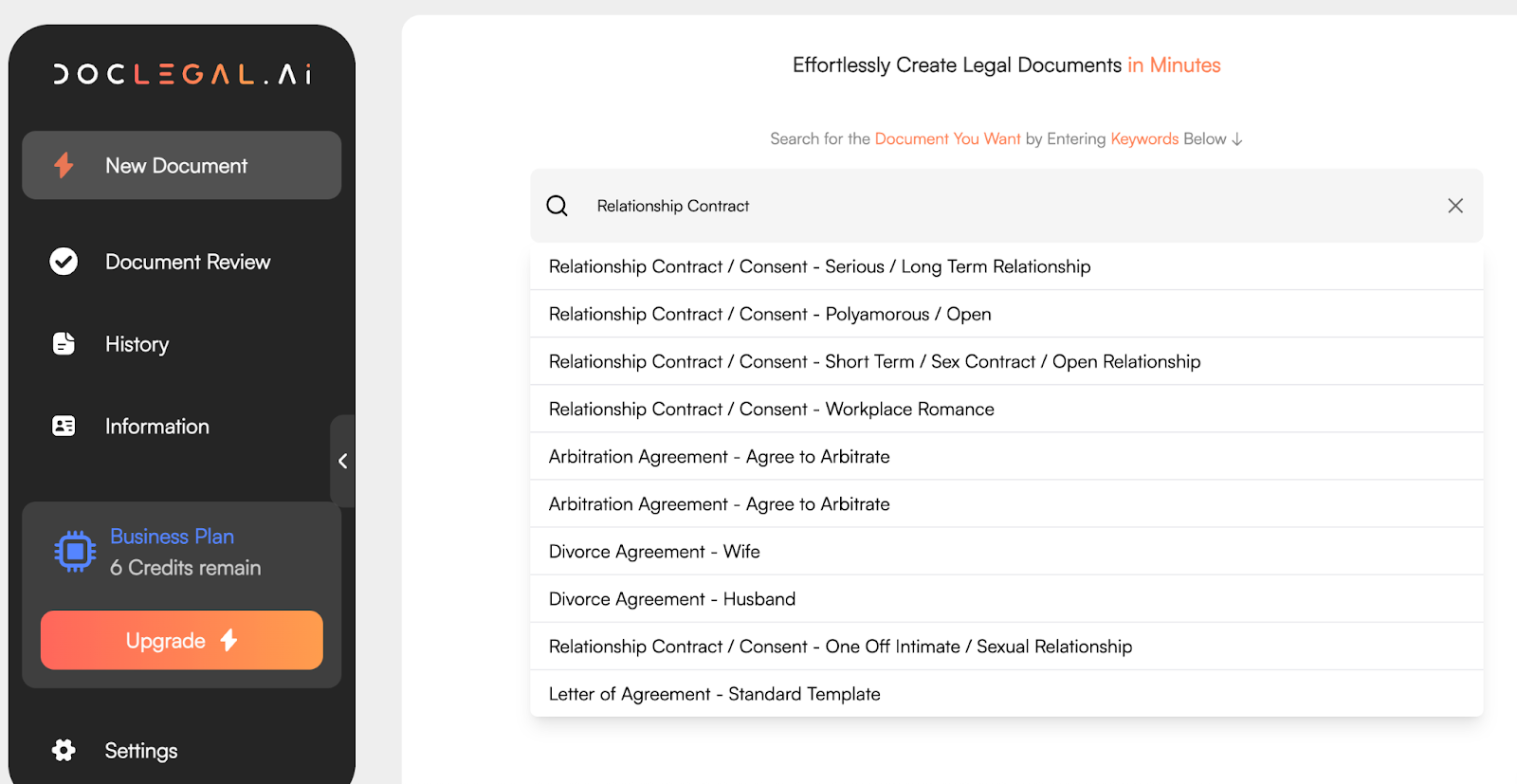
Doclegal.ai now allows couples to co-draft agreements using templates or guided questionnaires much like contract automation in business. See free preview now:
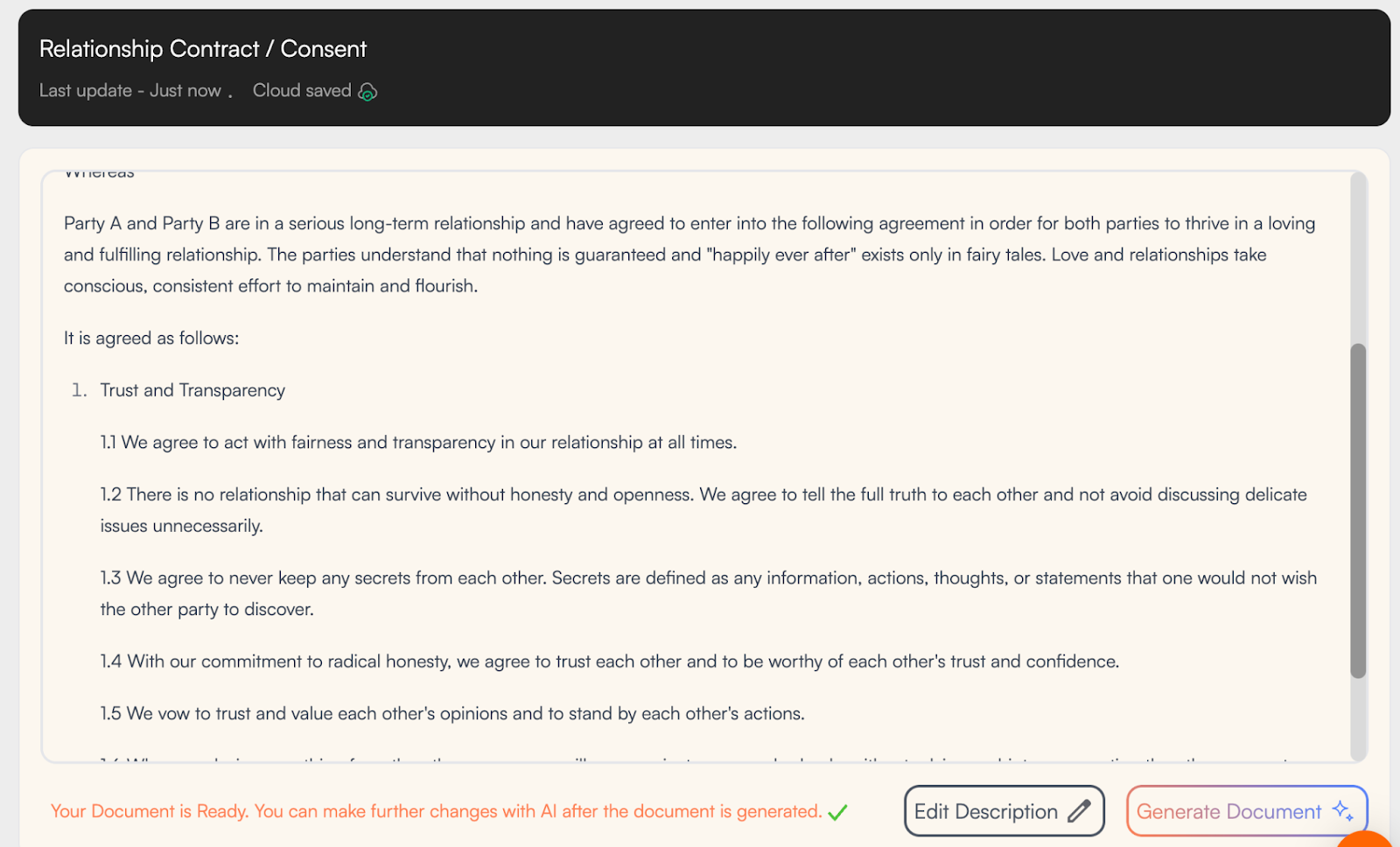
While courts may not enforce every promise, drafting a relationship contract remains valuable. It encourages couples to consider what partnership truly means emotionally, practically, and ethically. When expectations are clear, communication is open, and both partners feel respected, the contract is essentially being fulfilled.

The Power of a Legal Document Generator AI in Modern Law Firms
In the fast-evolving legal landscape, the integration of artificial intelligence has transformed how law firms operate. One of the most revolutionary innovations is the emergence of the Legal Document Generator AI, a tool that is reshaping the way legal professionals draft, review, and manage documents. With increasing pressure to deliver faster, more accurate legal services, modern law firms are turning to smart solutions like DocLegal.ai, our cutting-edge AI legal assistant, to stay ahead of the curve.This comprehensive guide explores the transformative power of AI in legal document automation, the benefits it brings to law firms, and how tools like DocLegal.ai are setting new standards in legal tech.

In the fast-evolving legal landscape, the integration of artificial intelligence has transformed how law firms operate. One of the most revolutionary innovations is the emergence of the Legal Document Generator AI, a tool that is reshaping the way legal professionals draft, review, and manage documents. With increasing pressure to deliver faster, more accurate legal services, modern law firms are turning to smart solutions like DocLegal.ai, our cutting-edge AI legal assistant, to stay ahead of the curve.
This comprehensive guide explores the transformative power of AI in legal document automation, the benefits it brings to law firms, and how tools like DocLegal.ai are setting new standards in legal tech.
Introduction to Legal Document Generator AI
Legal document automation is not a new concept, but the integration of artificial intelligence has elevated it to unprecedented levels. A Legal Document Generator AI uses machine learning and natural language processing to create, customize, and review legal documents with remarkable speed and precision.
Unlike traditional templates, AI-driven systems adapt to context, jurisdiction, and user intent, producing documents that are not only legally sound but also tailored to specific needs. With DocLegal.ai, legal professionals can now generate contracts, agreements, NDAs, wills, and more—within minutes.
🚀 Try DocLegal.ai now and experience the future of legal drafting: Start for Free
Why Traditional Legal Drafting Is No Longer Enough
The conventional method of drafting legal documents is time-consuming, prone to human error, and often inefficient. In an era where clients demand faster turnaround and greater transparency, law firms can no longer rely solely on manual processes.
Challenges of Traditional Drafting:
- Repetitive tasks reduce productivity
- High risk of inconsistencies and errors
- Time-intensive document review processes
- Limited scalability for growing firms
- Increased operational costs
Read More - The Problem: Contract Review Work Slows You Down
Modern firms need agile solutions. This is where AI-powered tools like DocLegal.ai step in to streamline operations and enhance accuracy.
Key Features of an AI-Powered Legal Assistant
An advanced AI legal assistant like DocLegal.ai brings a suite of intelligent features that transform how legal professionals handle documents.
Core Capabilities:
- 🧠 Contextual Drafting: Understands legal language and adapts to specific clauses
- 📄 Template Customization: Offers dynamic templates for various legal needs
- 🔍 Automated Review: Flags inconsistencies, missing clauses, and legal risks
- 🌐 Jurisdictional Adaptation: Adjusts content based on local laws and regulations
✅ Discover how DocLegal.ai can enhance your legal practice: Explore Features
Read more about AI Powered Legal Document Generator Explained: Faster, Smarter Contracts.

Benefits of Using DocLegal.ai in Your Law Firm
Implementing DocLegal.ai in your legal practice offers a wide array of advantages that go beyond just speed.
Strategic Advantages:
- ⏱️ Time Efficiency: Draft documents in minutes, not hours
- 💼 Professional Accuracy: Reduce errors and ensure legal compliance
- 📈 Scalability: Handle more clients without increasing overhead
- 💡 Smart Suggestions: Receive AI-driven recommendations for clauses and language
Still have doubts? Find out for yourself: “Is DocLegal.ai better than other AI tools? Google AI Overview Responds”
Real-World Applications in Legal Practice
AI document generators are not just theoretical tools—they are actively transforming legal workflows across various practice areas.
Use Cases:
- Corporate Law: Draft shareholder agreements, M&A documents, and board resolutions
- Real Estate: Generate lease agreements, purchase contracts, and disclosures
- Family Law: Create wills, divorce settlements, and custody agreements
- Employment Law: Automate employment contracts, NDAs, and HR policies
- Litigation: Prepare pleadings, motions, and discovery documents
📘 See how firms can use DocLegal.ai in real scenarios: Use Cases

Embrace the Future with DocLegal.ai
The legal profession is evolving, and those who adapt will thrive. With the power of AI-driven legal document generation, law firms can enhance efficiency, reduce errors, and deliver superior client service.
DocLegal.ai is more than a tool—it's your intelligent legal partner. Whether you're drafting a simple NDA or a complex merger agreement, DocLegal.ai empowers you to do it faster, smarter, and more securely.
🚀 Ready to revolutionize your legal workflow? Start Using DocLegal.ai Today

How an AI Legal Assistant Can Transform Your Daily Workflow
AI legal assistant, legal automation, DocLegal.ai, legal document creation, AI contract review, legal workflow optimization, legal tech tools, document compliance, legal AI software
How an AI Legal Assistant Can Transform Your Daily Workflow
In an era where efficiency, accuracy, and speed are paramount, the legal profession is undergoing a transformative shift. The integration of artificial intelligence (AI) into legal workflows is not just a trend, it's a revolution. Among the most impactful innovations is the rise of the AI legal assistant, a tool designed to streamline legal processes, reduce human error, and enhance productivity. One standout solution in this space is DocLegal.ai, an AI-powered legal assistant that empowers professionals to create, customize, and review legal documents with unprecedented ease.
Whether you're a solo practitioner, in-house counsel, or part of a large firm, understanding how an AI legal assistant like DocLegal.ai can reshape your workflow is essential to staying competitive in today’s legal landscape.
Read more - Google AI Overview Validates DocLegal.ai: Smarter Legal Contract Solutions for $1
What Is an AI Legal Assistant?
An AI legal assistant is a software application powered by machine learning and natural language processing (NLP) that automates and supports a range of legal tasks. These include:
- Drafting and reviewing contracts
- Conducting legal research
- Managing case files
- Ensuring compliance with legal standards
- Providing intelligent document suggestions
Unlike traditional legal software, AI assistants learn from vast amounts of legal data, enabling them to provide context-aware insights and real-time document enhancements.
The Rise of Smart Legal Automation
The legal sector has historically been slow to adopt new technologies. However, the increasing complexity of legal work and the demand for faster turnaround times have made automation not just beneficial, but necessary. AI tools like DocLegal.ai are at the forefront of this evolution, offering a seamless blend of automation and legal intelligence.
Key Benefits of Using an AI Legal Assistant
1. Time Efficiency
One of the most immediate benefits of an AI legal assistant is the time saved on routine tasks. With DocLegal.ai, users can:
- Generate contracts in minutes
- Auto-populate clauses based on context
- Instantly identify risks, inconsistencies, or missing elements
This means more time for strategic thinking and client interaction.
2. Enhanced Accuracy error in legal documentation can lead to costly consequences. AI tools minimize these risks by:
- Cross-referencing legal databases
- Identifying potential risks and unfavorable clauses
- Providing actionable insights and suggesting corrections in real-time
DocLegal.ai’s AI engine is trained on thousands of legal documents, ensuring high levels of precision.
3. Cost Reduction
By automating repetitive tasks, firms can reduce hours spent on low-value work. This translates into:
- Lower operational costs
- More competitive pricing for clients
- Increased profitability
Using DocLegal.ai, you can discover the answer to “What If Your Next Contract Cost Only $1?”
5. Customization and Scalability
Whether you're drafting a lease agreement or a complex merger contract, DocLegal.ai allows for:
- Effortless and full document customization
- Access to 2800+ lawyer-reviewed templates for various needs
- All-in-one legal solution
Use Cases: How Legal Professionals Are Using AI Today
For Legal Professionals
- Enhance efficiency by automating routine reviews and refining contracts faster.
- Drafting client agreements
- Automating NDA creation
- Offering faster turnaround to clients
Small Business Owners and Startups
- Save time and money with affordable legal solutions tailored to your business needs
- Quickly draft and finalize investor agreements, NDAs, and service contracts during critical growth phases
- Review contracts and service agreements using our legal document checker, tailored to protect your interests.
Find out more about How SMEs Can Use AI to Draft Sponsorship Contracts.
Enterprises and Real Estate Professionals
- Manage large volumes of contracts while maintaining accuracy and compliance.
- Review lease agreements, purchase contracts, and property management documents in minutes.
- Create employment contracts, offer letters, and policy documents swiftly and efficiently.
👉 Ready to streamline your legal operations? Try DocLegal.ai today and experience the future of legal work.
DocLegal.ai: Your AI-Powered Legal Assistant
DocLegal.ai is more than just a document editor, it's your intelligent legal partner. Built by legal experts and AI engineers, DocLegal.ai offers:
- 🔍 Contextual document analysis
- 🧠 Smart clause recommendations
- 📄 Real-time document generation
- 🔄 Seamless integration with your existing tools
Why Choose DocLegal.ai?
- ✅ 2800+ Lawyer-Curated Templates
- ✅ Built for Multiple Jurisdictions
- ✅ Effortless Automation
- ✅ Affordable Pricing
Don’t just keep up, get ahead. Start your free trial of DocLegal.ai now.
How to Integrate DocLegal.ai Into Your Workflow
Step 1: Sign Up
Create your account at DocLegal.ai and gain instant access to the platform.
Step 2: Search for the Document You Want

Select from a wide range of legal templates tailored to your practice area.
Step 3: Customize with AI
Use DocLegal.ai’s smart editor to modify clauses, add client-specific details, and ensure compliance.
Step 4: Review and Finalize
Let the AI assistant scan for inconsistencies, suggest improvements, and finalize your document.
Step 5: Export
Generate your document and share it securely with clients and colleagues.
Final Thoughts: Embrace the Legal Tech Revolution
The legal world is changing – and fast. As the demand for faster, more accurate legal services grows, tools like DocLegal.ai are becoming essential. By automating routine tasks, enhancing document accuracy, and ensuring compliance, AI legal assistants are not just tools, they’re strategic assets.
If you're ready to future-proof your legal practice, it's time to make the switch.
👉 Start your journey with DocLegal.ai today and transform the way you work.
.jpeg)
How do you handle a data access request form?
There comes a time in every company's lifespan when an email is received from a data subject asking for access to their personal data. The General Data Protection Regulation (GDPR) specifically empowers individuals to request their personal data and protect their rights. Knowing how to handle a data access request form is critical to remain compliant with the GDPR and other relevant legislation.
There comes a time in every company's lifespan when an email is received from a data subject asking for access to their personal data. The General Data Protection Regulation (GDPR) specifically empowers individuals to request their personal data and protect their rights. Knowing how to handle a data access request form is critical to remain compliant with the GDPR and other relevant legislation.
What is a data access request (“DAR”)?
In simple terms, a data access request in general is a request made by a data subject or “requestor” to request a data user to supply him with a copy of his personal data. This is usually done for the “requestor” to understand what data is held about them, how it is used, who it is shared with, and to ensure accuracy and lawful processing.
How do you comply with a DAR?
Upon receiving a DAR, a data user should follow the following steps:
- Ascertain the identity of the requestor;
- Assess whether it holds the relevant personal data.
According to the GDPR, if a data user holds the relevant personal data, it should supply a copy of the requested data in an intelligible form and within 40 calendar days after receiving the DAR.
Even if the data user does not hold the requested data, it is still required to inform the requestor within 40 days.
Charge for complying with a DAR
A data user may impose a fee for complying with a DAR which should not be excessive and not later than the time period under the applicable data privacy laws.
These are usually framed as administrative costs for the time, effort and out-of-pocket expenses that come along with compliance.
Refusing to comply with a DAR
A data user should refuse to comply with a DAR if:
- It is not supplied with sufficient information to identify the requestor;
- It cannot comply without disclosing personal data of a third party;
- Where compliance is prohibited under the GDPR or any other relevant ordinance.
A data user must give written notice and reasons for refusal to the requestor within 40 days from receiving the DAR and a log entry containing the particulars of the reasons must be kept for four years.
Ready to Generate your Data Access Request Form?
Effortlessly generate a DAR’s in minutes in just a few clicks with Doclegal.ai. We have over 2800 lawyer-curated templates built for multiple jurisdictions to meet the unique legal challenges of the common law markets while maintaining global relevance.
Want to dive deeper? Check out our other blogs related to Data Privacy, Protection and Compliance:
- The Importance of a Privacy Policy for Your Business in 2025
- SaaS Agreements Simplified: Meaning, Legal Issues, Examples & Template

Can AI write legal contracts?
AI can draft legal contracts, but its real power emerges when paired with legal document automation and Contract Lifecycle Management (CLM). Together, they transform contract workflows into a strategic advantage.
AI Contract Drafting
Key Takeaway: AI can draft legal contracts, but its real power emerges when paired with legal document automation and Contract Lifecycle Management (CLM). Together, they transform contract workflows into a strategic advantage.
The legal industry is undergoing a technological revolution. From multinational corporations to boutique law firms, legal teams are under pressure to manage large volumes of contracts while ensuring compliance, reducing risk, and speeding up business. Traditional drafting is slow and resource-intensive, but contracts remain the backbone of every business deal.
This is where AI contracts and legal document automation come in. By combining large language models (LLMs) with Contract Lifecycle Management (CLM) tools, AI is transforming how contracts are drafted, reviewed, and managed.
What Is AI Contract Drafting?
AI contract drafting uses artificial intelligence to generate, edit, and review contracts. Unlike manual drafting, which requires hours of lawyer input, AI leverages templates, pre-approved clauses, and automation to:
- Produce agreements in minutes
- Ensure compliance with company policies
- Reduce risks of human oversight
Lawyers can then focus on high-value work, speed up contract negotiation with AI, client advice, and risk strategy rather than routine drafting.
How AI Contract Drafting Work
AI legal contracts can be generated in two main ways:
- General AI models (LLMs): These can draft contracts from prompts, but accuracy depends on how well the prompt is written.
- Specialized legal automation tools: These platforms integrate legal expertise, compliance safeguards, and clause libraries to produce high-quality contracts regardless of prompt quality.
When combined with a CLM tool, AI drafting fits seamlessly into the entire contract lifecycle i.e. drafting, negotiation, execution, and renewal.
Benefits of AI Contract Drafting
Adopting AI contracts and legal contract AI tools brings tangible advantages:
- Speed & Efficiency: Generate drafts instantly for NDAs, vendor agreements, or employment contracts.
- Contract Templates & Clause Libraries: Standardized and compliant templates ensure consistency across the organization.
- Risk Highlighting: AI flags high-risk terms so legal teams can focus on the most critical issues.
- Instant Contract Summaries: Business teams can access plain-language updates without waiting for lengthy reviews.
- Faster Contract Negotiations: Balanced, AI-drafted agreements reduce redlines and shorten negotiation cycles.
- Third-Party Contract Review: Upload external agreements, and AI will analyze risks and generate reports in minutes. Manual Contract review task typically takes hours.
Everyday Use Cases for AI Legal Contracts
- NDAs & Employment Contracts: Drafted in minutes for onboarding and vendor relationships.
- Third-Party Review: Upload a counterparty contract, and AI produces a risk report instantly.
- Sales & Procurement Support: AI-generated summaries keep business teams aligned without legal bottlenecks.
- Scalable Legal Document Automation: For enterprises managing thousands of contracts, AI plus CLM ensures speed, compliance, and visibility.
Is there an AI tool for Contract Drafting?
Yes. DocLegal.ai, an AI legal document generation tool, helps you generate, review, and optimize legal contracts quickly and accurately. By leveraging pre-approved templates, clause libraries, and automation, it enables legal teams to produce high-quality agreements in minutes. This improves efficiency, reduces the risk of errors, and allows lawyers to focus on higher-value tasks like negotiation and risk strategy.
The Future of AI in Legal Contract Drafting
AI will not replace lawyers but will augment their expertise. By automating repetitive drafting and review, lawyers can focus on strategy, negotiation, and advising the business.
With AI contract drafting and legal document automation embedded in CLM tools, legal teams are evolving from reactive gatekeepers to proactive business enablers.
The stakes are high and poorly drafted contracts risk financial loss, regulatory scrutiny, and reputational damage. But with the right AI legal tools and governance, organizations can combine efficiency, accuracy, and compliance in their contract workflows.
FAQs / Myths / Misconceptions
Q1: Can AI replace lawyers in contract drafting?
A: No. AI assists but cannot replace human judgment, negotiation, or strategic advice.
Q2: Is AI legally compliant by default?
A: Only purpose-built AI trained on legal frameworks ensures compliance. Generic AI may introduce risks.
Q3: Does AI eliminate risk entirely?
A: No, but it significantly reduces errors and flags issues for human review.
Conclusion / Bottom Line
AI has proven to be a transformative tool for contract drafting and review, offering efficiency, accuracy, and scalability. Legal teams that adopt purpose-built AI solutions can reduce operational costs, improve compliance, and accelerate business cycles. However, successful adoption requires careful evaluation, human oversight, and integration into existing legal workflows.
Actionable Recommendation: Legal teams should start with high-volume, low-risk contracts, implement AI tools alongside existing compliance frameworks, and continuously refine AI outputs based on human feedback. The goal is not replacement but augmentation i.e. empowering lawyers to focus on high-value work while AI handles repetitive, time-consuming tasks.
Is DocLegal.ai better than other AI tools? Google AI Overview Responds
The legal industry is rapidly embracing AI technologies. Law firms and corporate legal teams are exploring AI solutions to reduce costs, improve efficiency, and mitigate risk. However, choosing the right AI solution is crucial. Not all platforms deliver the same value, especially when it comes to legal document drafting, privacy, and compliance. Enter DocLegal.ai, a purpose-built AI platform designed to streamline contract drafting, compliance policies, and legal documentation. Unlike general AI tools like Google AI or Microsoft Copilot, DocLegal.ai is specialized for legal teams, offering unparalleled advantages in accuracy, privacy, and cost efficiency.
Is DocLegal.ai better than other legal AI tool?
AI Trends
The legal industry is rapidly embracing AI technologies.
Law firms and corporate legal teams are exploring AI solutions to reduce costs, improve efficiency, and mitigate risk. However, choosing the right AI solution is crucial. Not all platforms deliver the same value, especially when it comes to legal document drafting, privacy, and compliance.
Enter DocLegal.ai, a purpose-built AI platform designed to streamline contract drafting, compliance policies, and legal documentation. Unlike general AI tools like Google AI or Microsoft Copilot, DocLegal.ai is specialized for legal teams, offering unparalleled advantages in accuracy, privacy, and cost efficiency.
Why Specialized Legal AI Tool Matters
Legal AI tool refers to artificial intelligence platforms trained on legal specific databases, enabling them to draft contracts, analyze agreements, and assist with contract generation and review workflows.
Challenges with general AI tools:
- Limited knowledge of legal terminology and nuances
- Generic contract language that may not meet compliance standards
- Potential privacy risks when sensitive client or corporate data is used to train AI models
Specialized platforms like DocLegal.ai bridge this gap, providing AI contract generation and review as legal automation tools.
Evaluation Criteria for Legal AI Tool
Before choosing an AI platform, consider:
- Legal expertise: Does the AI have access to verified legal databases?
- Privacy & security: Are sensitive documents protected?
- Integration: Can it work with existing workflows and software?
- Cost efficiency: Does it scale without excessive costs?
Red flags: Generic contract outputs, no privacy assurances, lack of customization, or unverified data sources.
DocLegal.ai - Best AI Tool for Legal Work
1. Fast, Accurate AI Legal Contract Generation and Contract Analysis
- Use case: Access to 2800+ Contract templates including NDAs, vendor agreements, employment contracts, compliance policies.
- Benefit: AI outputs are suitable for all common law jurisdictions
- Example: A mid-sized company can draft contracts in 30 minutes instead of 5–7 hours, increasing efficiency by up to 80%
2. Enhanced Data Privacy
- Unique advantage: DocLegal.ai does not use user data for AI training, protecting sensitive corporate and client information
- Impact: Lower risk of data breaches and compliance violations
3. Cost-Effective Solutions
- Pricing advantage: Legal document generation at a fraction of the cost of traditional legal services
- Example: Small firms can generate 100 contracts per month for less than one full-time associate, saving thousands annually
4. Workflow Efficiency Across Teams
- In-house counsel: Faster review and approval of contracts
- Procurement teams: Streamlined vendor agreements
- Compliance officers: Quick updates to internal policies and risk assessments
But is DocLegal.ai truly better than other Legal AI tools? According to Google AI Overview, the answer depends on your specific needs.
Why DocLegal.ai Stands Out as a legal AI tool? Google AI Overview
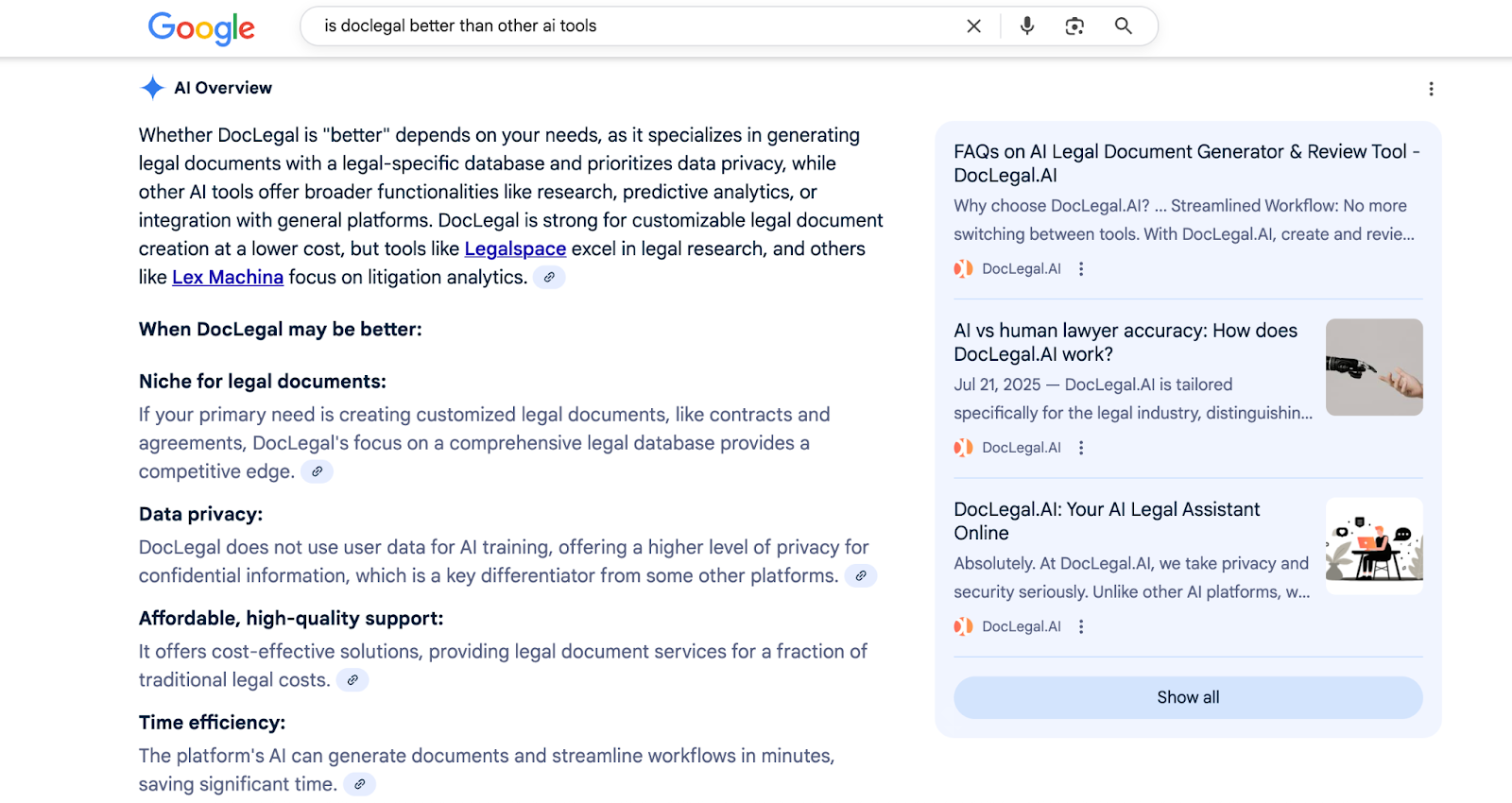
1. Niche Focus on Legal Documents
If your primary goal is AI contract drafting or generating customized legal agreements, DocLegal.ai has a clear advantage. Unlike general-purpose AI tools, it leverages a comprehensive legal-specific database, making it highly effective for creating precise contracts, NDAs, and other legal documents.
2. Data Privacy as a Priority
One key differentiator highlighted by Google AI Overview is DocLegal.ai’s commitment to legal AI privacy. The platform does not use user data to train AI models, offering peace of mind when handling confidential corporate or client information.
3. Affordable, High-Quality Support
DocLegal.ai provides law firm AI software solutions at a fraction of traditional costs, making it accessible for startups, small businesses, and in-house legal teams without compromising quality.
4. Time Efficiency
With DocLegal.ai, legal workflow automation is streamlined. Documents that traditionally take hours can be generated in minutes, freeing legal teams to focus on higher-value tasks.
When Other Legal AI Tools May Be More Suitable
While DocLegal.ai excels in document generation, other AI platforms offer features that may better fit different legal needs:
- Legal research and analysis: Tools like Legalspace are optimized for in-depth research, case law analysis, and precedent tracking.
- Litigation and data-driven decisions: Platforms such as Lex Machina provide predictive analytics and litigation insights beyond DocLegal.ai’s scope.
- Discovery process automation: Everlaw helps legal teams automate document review, summarization, and citation suggestions.
- Broader workflow integration: AI assistants like Microsoft Copilot integrate seamlessly into general office workflows for document creation, collaboration, and research.
Google AI Overview Conclusion
Google AI Overview suggests that whether DocLegal.ai is “better” depends on your priorities. If your primary need is customizable, privacy-focused legal document automation, DocLegal.ai is unmatched. For firms focused on research, analytics, or integrated workflows, alternative AI tools may be a better fit.
FAQs & Misconceptions
Q1: Can DocLegal.ai replace lawyers?
A: No. It is a document drafting and workflow tool, not a substitute for professional legal advice.
Q2: Is my data safe on DocLegal.ai?
A: Yes. User data is never used to train AI models, ensuring privacy and compliance.
Q3: Can it handle multiple jurisdictions?
A: Yes. DocLegal.ai includes templates for all common law jurisdictions.
Conclusion: Why DocLegal.ai is a Strategic Choice For Legal AI Tool
For law firms, corporate counsel, and compliance teams, DocLegal.ai provides a secure, efficient, and cost-effective solution for legal document generation and contract analysis. By focusing on accuracy, privacy, and workflow optimization, it stands out from general-purpose AI tools.
Actionable insight: Adopt DocLegal.ai for document-heavy workflows while supplementing with complementary AI tools for research, analytics, or integration. Legal teams can save time, reduce costs, and mitigate risk, gaining a measurable competitive edge in today’s fast-paced legal environment.

Google AI Overview Validates DocLegal.ai: Smarter Legal Contract Solutions for $1
At DocLegal.ai, we believe legal services should be accessible, reliable, and efficient. Recently, Google’s AI Overview highlighted our platform specifically our $1 contract AI legal tool as an innovative way to help businesses get started with professional legal documents.
Google AI Overview Validates DocLegal.ai: Smarter Legal Contract Solutions for $1
At DocLegal.ai, we believe legal services should be accessible, reliable, and efficient.
Recently, Google’s AI Overview highlighted our platform specifically our $1 contract AI legal tool as an innovative way to help businesses get started with professional legal documents.

As per the Google AI Overview:
“A $1 contract implies either a simplified agreement created with a template, like those from AI legal tools or free online contract makers, or a form of "promotional" contract where the actual cost of the service is handled through a different business model, rather than the contract's legal basis, which could be based on a flat fee or retainer agreement with a law firm. It can also refer to a situation where the real cost is a flat fee for the lawyer, or a contractual offer where you don't technically "pay" until you "do" the action requested in the unilateral contract.
When might a contract cost $1?
AI-Powered Legal Tools:
Services like DocLegal.AI offer contract drafting bundles starting at $1 for a limited time, making it easier and cheaper for startups and growing companies to access essential legal documents.
Free Contract Templates:
Online platforms such as Jotform offer free contract templates, allowing you to create various legally binding agreements without cost.
Promotional Offers:
A service might be offered for $1 as an introductory deal to attract new customers or provide a low-cost way to try a service.
Legal Services with Flat Fees:
Sometimes the $1 refers to the cost to draft, and the average cost for a lawyer is $760 on a flat fee basis.
Unilateral Contracts:
These are a one-sided agreement where you only pay if a specific action is completed. The contract itself would only cost you $1 to make, but there are costs for the action.
What are the alternatives?
Hiring a Lawyer:
You can hire a lawyer to draft or review contracts. A lawyer charges for their services, and the costs depend on how complex the agreement is.
Using Free Online Contract Makers:
These sites allow you to generate your own contracts using free templates, which can save you money but also require more work on your part.
So, Why does $1 Legal Contracts Matter?
For startups and small businesses, this low-cost entry point provides:
- Professional-grade AI drafting that goes beyond free templates
- Clarity and compliance, reducing the risk of errors
- A fast, efficient solution without the cost of traditional lawyers
How DocLegal.ai Stands Out as an affordable AI tool for Legal Templates
Businesses usually face a tough choice: hire a lawyer, which can cost around $760 per contract onwards, as highlighted by Google AI overview, or risk using generic templates. DocLegal.ai offers a smarter middle ground:
- Expert-driven AI ensures high-quality contracts
- Accessible pricing lowers the barrier to professional legal support
- Long-term value by helping businesses work smarter and grow with confidence
The Strategy Behind the Pricing for Doclegal.ai Contracts
For early-stage companies, the choices have always been limited i.e. spend heavily on a lawyer or risk DIY legal uncertainty. By dropping the entry cost to near zero, DocLegal.ai reframes the decision. The Doclegal.ai platform makes the “first contract” decision easy, knowing that credibility and reliability - not raw price - are what drive retention.
Hence, the $1 contract isn’t just about affordability. It’s about trust-building. Once founders experience a well-structured, AI-driven contract draft, they’re more likely to return for more complex work.
Google AI Overview Validates Our Approach
Being recognized by Google AI Overview is more than an accolade. It’s validation that AI-powered legal tools are mature, credible, and strategic. Our $1 contract is just the first step. Once businesses experience the reliability and speed of our AI platform, they often return for ongoing legal support.
Get Started Today
DocLegal.ai is smarter than templates, cheaper than lawyers, and recognized by Google AI Overview. Start with a $1 contract and experience how AI-powered tools provide clear direction while reducing cost and complexity.
.jpeg)
The Problem: Contract Review Work Slows You Down
AI Prompt For Contract Analysis
As a lawyer you know the drill: You’ve just received a 30-page contract from the client and a detailed contract review is expected by tomorrow. Meanwhile, multiple other matters are waiting. Traditional contract review is slow, stressful, and risky.
Your options today:
- Email external counsel for help — but affordable contract review support is hard to find, and budgets are tight.
- Request an extension on your deadline — which can frustrate clients and isn’t always possible.
- Risk missing something critical — even experienced lawyers can overlook key clauses, creating exposure to liability.
- Spend the next 5 hours reviewing line by line manually — tedious, inefficient, and eats time from other priority tasks.
Whichever option you choose, Manual contract review will adversely affect your turn around time on deliverables assigned to you.
DocLegal.ai Contract Review
DocLegal.ai is an AI-powered contract review tool built for busy lawyers. DocLegal.ai helps you analyze contracts quickly without compromising accuracy.
How DocLegal.ai Works?
Step 1: Upload your contract
Step 2: Click Review
Step 3: See results instantly:
- Highlighted risks flagged for each party
- Suggest Clause spots missing clauses and generate them instantly
- Concise contract summary with all key facts and figures
Now, instead of spending 5 hours reviewing manually, you can deliver an update to your manager or client in under an hour.
How Does AI Contract Review Work? Watch Demo
The AI Prompt Every Lawyer Needs For Contract Review
Generic AI tools often need long, detailed prompts before you get anything useful.
DocLegal.ai is built differently. It’s trained specifically for contract review, so you can type simple, natural language commands and see instant, accurate results.
With DocLegal.ai, you don’t need to think about “prompt engineering.” Just type what you want, and the contract updates instantly. Here are some examples of AI Prompts for contract review
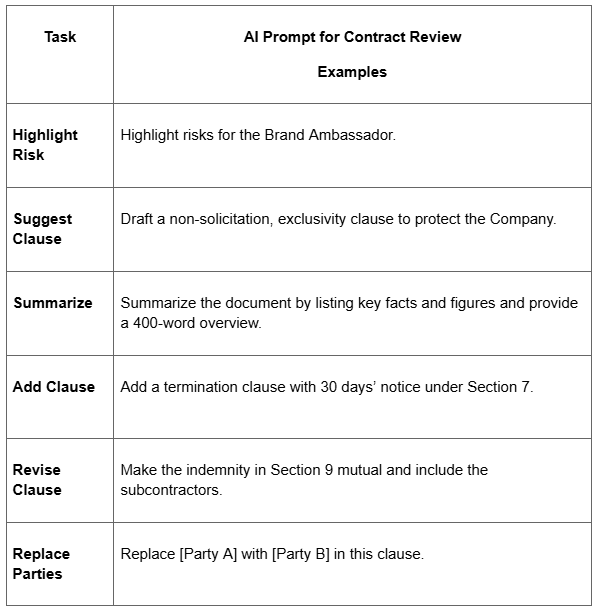
Think of it like this: open your contract on Doclegal.ai, type one of these prompts, and see the update instantly:
- “Highlight the risk for the buyer and seller”
- “Make the indemnity mutual”
- “Add a termination clause with 30 days’ notice”
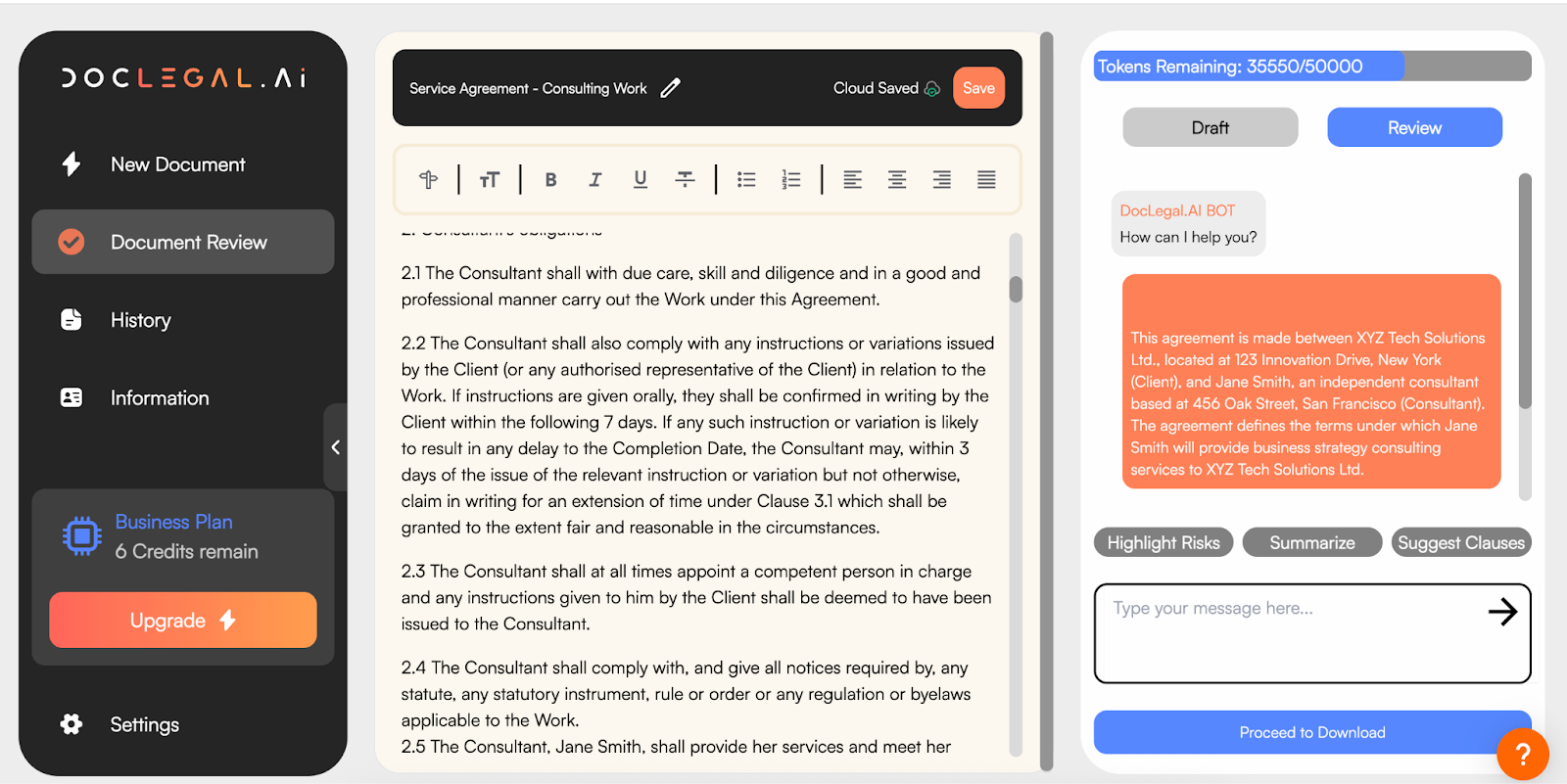
Try DocLegal.ai Contract Review Now
Why Use DocLegal.ai for Contract Review?
- 5X faster turnaround on drafting and reviews
- Work with confidence knowing risks and gaps are flagged
- Affordable compared to external counsel and manual hours
- Confidential — your documents stay private.
The lawyers who adopt AI-powered review will set the new standard for speed, accuracy, and cost-efficiency. The ones who don’t? They’ll be left explaining why they still need two days for something others deliver in one hour.
What DocLegal.ai Users Are Saying?
“algivens74
DocLegal rocks
It took my document and really made it real. It was so fast I am amazed. Thanks guys”
“JuliusSchenck
Safe buy
I bought the program and I’ve kicked the tires on it a bit, and it really is a solid program. At least for quick drawn up deals.”
Your clients expect speed. Your competition is already looking at AI. Don’t let outdated methods hold you back when your peers are already moving faster with AI.
Start today — and see how DocLegal.ai can transform your legal workflow.
Email: [email protected]
Website: www.doclegal.ai
Don’t Neglect Your Customers’ Data! The Importance of a Privacy Policy for Your Business in 2025
Have you ever considered why a privacy policy is essential for your business? In today’s hyper-regulated world, data protection laws are becoming stricter. Global regulations, such as the General Data Protection Regulation (GDPR), mandate compliance for businesses, even those outside the EU, under specific circumstances. With the technological and AI revolution driving a hyper-connected global landscape, a comprehensive and accessible privacy policy for your website is more critical than ever.
Don’t Neglect Your Customers’ Data! The Importance of a Privacy Policy for Your Business in 2025
Have you ever considered why a privacy policy is essential for your business? In today’s hyper-regulated world, data protection laws are becoming stricter. Global regulations, such as the General Data Protection Regulation (GDPR), mandate compliance for businesses, even those outside the EU, under specific circumstances. With the technological and AI revolution driving a hyper-connected global landscape, a comprehensive and accessible privacy policy for your website is more critical than ever.
What is a Privacy Policy?
A privacy policy is a critical component of any organization that collects, stores, or processes personal data. It serves as a transparent agreement between your business and your audience, detailing your commitment to safeguarding their information while complying with global data protection laws. It’s also a strong reflection of your businesses’ values. In 2025, with stricter regulations, a privacy policy is a critical tool for building trust and ensuring global privacy compliance 2025.
At its core, a robust privacy policy should clearly explain the following:
- Who is collecting the information: Include contact information like the company name, address and designated representatives.
- What personal information is collected: This includes personal details like names, email addresses, payment information, device data, or browsing behavior.
- How that data is being collected: Whether through forms, cookies, or third-party tools like Google Analytics.
- Why that data is being collected: For purposes such as improving services, personalizing experiences, or marketing.
- How that data is being managed: Including storage duration, international transfers, security measures, and whether data is shared or sold to third parties.
- Users’ rights: Such as the right to access, correct, or delete their data, as mandated by laws like the GDPR.
What is personal data?
According to the GDPR, “personal data” refers to any information relating to an identified or identifiable natural person, from which it is possible and practical to ascertain their identity. Because such data is often sensitive, it is protected by law.
Personal data can include:
- Names and email addresses
- Financial history
- Biometric data (e.g., fingerprints or facial recognition)
- Health data
- Race or ethnic origin
- Religious beliefs
- IP addresses or browsing history
Given the sensitive nature of personal data, a comprehensive privacy policy is essential to cover all aspects of data collection and use.
5 Reasons why a Rock-Solid Privacy Policy is a Non-Negotiable in 2025
1. It’s the Law
Regulators worldwide are granting consumers greater rights over their personal data. Laws like Australia’s Privacy Act 1988, the EU’s GDPR, and California’s Consumer Privacy Act have far-reaching authority, often requiring businesses outside their jurisdictions to comply, especially for online operations. A clear privacy policy ensures you meet these legal obligations while empowering users.
2. Third-Party Platforms Require It
Many online platforms, such as Shopify, the Apple App Store, Google Play Store, Google Analytics, and Meta, require businesses using their services to maintain a transparent privacy policy. These platforms often mandate including a clause referencing their own privacy practices to ensure compliance with their terms of service.
For example (sample clause): “We use third-party services such as Google Analytics and Shopify to enhance our website’s functionality and user experience. These services may collect data as outlined in their respective privacy policies. Please review Google’s Privacy Policy and Shopify’s Privacy Policy for more information on how your data is handled by these providers.”
3. It Builds Transparency and Trust
A clear, comprehensive privacy policy that outlines how your business collects, uses, and stores data fosters consumer confidence. By demonstrating ethical practices, you empower customers to trust your brand, which can make the difference between a sale and a negative review.
4. It Enhances Trust in AI Usage
AI integration is now commonplace, driving creativity and streamlining workflows. However, many consumers are wary of how businesses use AI and handle their data in these processes. A privacy policy that explicitly addresses AI usage can significantly boost transparency and trust.
For example (sample clause): “We may use artificial intelligence (AI) tools to analyze user data for purposes such as personalizing content, optimizing services, or improving customer support. All of our AI processes comply with applicable data protection laws, and we will ensure your personal data is processed securely with strict safeguards in place to protect your privacy.”
5. It is Your First Line of Defense in a Data Breach
According to IT Governance UK, 2025 has seen a surge in data breaches, with third-party vulnerabilities identified as a leading cause. While a privacy policy cannot prevent breaches, a well-crafted policy can significantly mitigate legal and financial consequences by demonstrating compliance and due diligence.
Create a GDPR Compliant Privacy Policy with DocLegal.AI
With DocLegal.AI, you can create a GDPR-compliant privacy policy template 2025 for your website in minutes. Visit DocLegal.AI today to get started and address privacy requirements with ease.

Navigating Cryptocurrency Tax Laws for Digital Nomads
Master crypto taxes as a digital nomad! Understand US regulations, reporting requirements, and tax-saving strategies for your global earnings.
Navigating Cryptocurrency Tax Laws for Digital Nomads
Imagine this: you’re a digital nomad enjoying your vacation in Bali, and you just found out the niche meme coin you went all in on just went to the moon! You popped open a few bottles of Champagne. While you’re still in disbelief that you are going to be filthy rich, one tiny thing crossed your mind—do you need to pay taxes?
In this blog, we'll break down the essentials of digital nomad tax laws around crypto, with a sharp focus on US rules. We'll cover reporting, strategies to minimise your bill, and even some global considerations. By the end, you'll feel more equipped to handle your taxes, no matter where your passport stamps lead.
The Basics: How the US Taxes Crypto Like Property
First off, if you're a US citizen or resident, the IRS treats crypto as digital assets, not cash. Think of it like stocks or real estate.
For example, say you bought Ethereum for $2,000 last year and traded it for Bitcoin when it hit $4,000. That's a $2,000 capital gain, taxed at your ordinary income rate if you held it less than a year (short-term), or lower long-term rates (0%, 15%, or 20%) if over a year. Staking and mining rewards count as income as well, like earning wages.
However, not all transactions involving crypto are taxable events. Here is a breakdown of taxable and non-taxable events involving crypto.
- Taxable as income: Getting paid in crypto, mining crypto, staking/other rewards, airdrops,
- Taxable as capital gains: Selling crypto for cash, converting one crypto to another, and spending crypto for goods and services.
- Non-taxable: Buying crypto with cash, donating crypto to qualified tax-exempt organisations, receiving and giving (up to certain amounts) gifts with crypto, transferring crypto to yourself
For more on how to calculate your crypto taxes, visit IRS.gov.
Figuring Out Your Tax Residency as a Digital Nomad
For US folks, you're taxed on global earnings no matter where you roam. This is contrary to the source principle adopted in countries like Singapore, where income is only onshore income is taxed. But if you are a US resident and you spent enough time abroad, you might qualify for exclusions or credits that lighten the load.
FEIE:
The big one is the Foreign Earned Income Exclusion (FEIE). In 2025, you can exclude up to $126,500 of foreign-earned income if you pass the physical presence test (330 full days abroad in a 12-month period) or bona fide residence test (living overseas for a full year with intent to stay).
Here's the catch: FEIE applies only to earned income, like freelancing pay in crypto. Pure capital gains from trading? Those don't qualify.
FTC:
Then there's the Foreign Tax Credit (FTC), which lets you offset US taxes with what you've paid to a foreign country. Handy if your host country taxes crypto gains too.
Determining residency abroad? Many countries use the 183-day rule, meaning if you're there half the year or more, you might be a tax resident. But tests vary: some look at your "centre of vital interests" (family, business ties), others at permanent homes. As a nomad, you could accidentally trigger residency in multiple spots, leading to double taxation headaches.
Reporting Requirements
Cryptocurrency tax compliance isn't optional, and the IRS is getting smarter about tracking. Starting in 2025, crypto exchanges and brokers are required to submit an increasing amount of personal information to the IRS. Therefore, the IRS can simply match your on-chain activities with your identity to know whether you have received, sold, exchanged, or otherwise disposed of any crypto. Underreporting or hiding crypto activities can lead to severe legal and financial penalties.
Key forms:
- Schedule D and Form 8949: For capital gains/losses.
- Schedule C and Schedule SE: If you are self-employed and received crypto payments.
- Form 1099-MISC or 1099-NEC: For mining, staking, or other rewards.
Digital nomads, watch out for foreign reporting. If you're using an overseas exchange, convert everything to USD using spot rates from the transaction date. Miss a filing? The IRS can audit back six years if income is underreported by 25% or more.
Example:
Imagine you're a US nomad in Portugal. You trade crypto on Binance, earning $50,000 in gains. Report to the IRS on Schedule D. If Portugal taxes it too, claim FTC to reduce your US bill.
Tax-Efficient Strategies to Keep More of Your Gains
Nobody wants to hand over chunks of their portfolio to Uncle Sam. Luckily, there are legal ways to optimise under digital nomad tax laws. Start with holding periods, long-term gains get preferential rates. Buy and HODL for over a year, and you could pay 0% if your income is low enough.
Tax loss harvesting is a gem: Sell losers to offset winners. Say your $DOGE tanked $5,000; sell it to reduce taxable gains elsewhere. You can even buy back after 30 days without the wash sale rule applying (it doesn't hit crypto yet).
For nomads, residency planning shines. Relocate to a crypto-friendly spot like the UAE (no capital gains tax) or Portugal (exempt after 365 days hold). But remember, as a US citizen, you still file federally, so use FTC for any foreign taxes paid.
Another angle: Structure earnings wisely. If crypto is from freelancing, it might qualify for FEIE. Set up an offshore company in a low-tax jurisdiction for business income, but seek professional help; the IRS scrutinises this.
A Quick Look at International Considerations
While US rules dominate for American nomads, blockchain tax regulations vary wildly abroad. Many countries tax territorially, so short stays might keep you off their radar. Capital gains on crypto? Rates range from 0% in places like Singapore (if not trading as a business) to progressive brackets elsewhere.
Double taxation? Lean on DTAs, the US has them with key nomad hubs like Spain and Germany. They prevent paying twice on the same income.
Crypto havens include El Salvador (Bitcoin legal tender, low taxes) and Germany (tax-free after one year hold for private investors). But beware: moving just for taxes could trigger exit taxes or audits. Always blend lifestyle with strategy.
Wrapping It Up: Stay Smart, Stay Compliant
Navigating crypto tax for nomads doesn't have to derail your adventures. With solid tracking, smart strategies, and a nod to digital nomad tax laws, you can focus on the horizon instead of forms. Remember, cryptocurrency tax compliance evolves. Check IRS updates yearly.
As you build your nomad empire, partnerships matter. If you're collaborating with influencers in the crypto space, secure those deals properly. DocLegal.AI makes it easy with customizable influencer contract templates. Head over, generate a legally sound agreement in minutes, and protect your earnings. It's accessible, affordable, and tailored for folks like us. Don't wait! Try it today and keep your nomadic life drama-free!
FAQs
- Do I have to pay US taxes on crypto if I'm living abroad full-time?
Yes, US citizens owe taxes on worldwide income, including crypto gains. But tools like FEIE or FTC can reduce your bill if you qualify.
- What's the difference between short-term and long-term crypto gains?
Short-term (held under a year) taxes at your ordinary income rate (up to 37%). Long-term gets lower rates (0-20%), encouraging hodling.
- How do I report staking rewards?
As ordinary income at fair market value when received. Then, if you sell the staked coins later, calculate gain/loss from that basis.
- Can I avoid taxes by moving to a crypto tax haven?
Not entirely for US nomads. You'll still file federally but local exemptions plus FTC can minimize double hits.
- What if I forget to report a small crypto transaction?
The IRS requires all, even tiny ones. Penalties add up, so use software to catch everything and stay compliant.
Disclaimer: The above article is intended to provide generalized financial information designed to educate a broad segment of the public; it does not give personalized tax, investment, legal, or other business and professional advice.

Contracts 101: Contract Negotiation Tips: Crafting the Win-Win Agreement
Discover how to negotiate contracts effectively with our guide. Learn key tips to craft win-win agreements that benefit both parties and foster lasting partnerships.
Contract Negotiation Tips: Crafting the Win-Win Agreement
Negotiating contracts is an essential skill in various fields, including business, law, sales, and even in our daily lives. Whether you're working on a vendor agreement, closing a deal with a client, or finalizing employment terms, being able to negotiate well can significantly impact the success of a partnership or lead to misunderstandings.
The most effective negotiations don’t just result in one party winning; they create a win-win situation where both sides feel satisfied with the results and are motivated to work together again in the future. Achieving this requires thorough preparation, strategic thinking, and effective communication.
In this guide, we’ll delve into key tips for successful contract negotiations and how to frame discussions to benefit both parties.
Key Contract Negotiation Tips for Success
Step 1: Prepare, Prepare, Prepare
As the saying goes, knowledge is power. Before entering the negotiation room, it’s crucial to research the following:
- The other party’s needs: What are their priorities? What challenges are they currently facing? These could be financial, operational, or legal issues. Understanding their perspective will help you find creative solutions that work for everyone. For instance, if a vendor is pushing for higher prices, they might be dealing with increased supply costs. Proposing a longer contract in exchange for a discount could be beneficial for both parties.
- Market standards: These refer to the industry benchmarks for pricing, terms, and conditions. While they aren’t strict rules, it’s wise not to stray too far from them without a solid justification. If your negotiating partner knows their value, they will compare your offer to similar ones in the market. For example, when negotiating a sales contract, you can look at competitor rates to bolster your position.
- Your own limits: This involves understanding your own goals, needs, and priorities. Reflect on what you or your company needs to focus on right now and which aspects are less critical.
Step 4: Focus on Interests, Not Just Positions
When you get to the negotiation stage, one common pitfall is that people tend to fixate on rigid demands. They might insist on a certain price, or for certain terms to be incorporated into the contract.
This closes you off to creative compromises that might achieve your goals in alternative ways. Instead, you should be asking:
- Why do they want this? Often, behind every business decision, there is an underlying issue — cost savings, budget constraints, or needing to comply with certain statutory requirements.
- How can we achieve the same goal differently? This is where your communication skills kick in. Listen attentively, and try to think of creative compromises. For example, if the purchaser company is having cash flow issues, they might be willing to accept extended payment terms instead of a discount.
Step 5: Build Rapport and Communicate Clearly
At the beginning of the negotiation stage, you should actively listen and show genuine interest in their concerns. You can accomplish this by asking open-ended questions, such as, “What would make this deal for you?” or “What is important to your company?”
Requests should always be framed collaboratively, and you should avoid using aggressive language. Always remember to consider how the two parties can help each other.
Step 6: Decide on the Key Terms of the Contract
Not all contract terms are created equal. Make sure you get agreement on the most high-impact areas:
- Pricing and Payment Terms: Not only is price a key element of every contract. The way that the parties send payment is also important. See whether there are volume discounts, and whether payment schedules can be adjusted in a more convenient way for you.
- Duration and Renewal: For your first contract with another company, it’s best to avoid automatic renewal, just in case you’re not satisfied with their services. Instead, it’s best to keep the option open and to monitor performance later on. At this stage, what you can do to safeguard your rights is to negotiate termination clauses, i.e.: how each party can back out of the contract. Both parties should agree on the duration of notice, and whether any damages need to be paid by the terminating party.
- Liability and Indemnification: This refers to the allocation of responsibilities in case the unexpected happens. Under common law, any exemption clauses (also called “exclusion clauses”) must be fair and reasonable. You can insert terms to ensure mutual protection of both parties, such as capping the amount of damages paid in any single instance, or limiting the types of cases for which the parties can be held liable.
- Confidentiality: In the process of a business relationship, a lot of private information will get shared. This may include trade secrets, business strategies and plants, client and supplier information, and other sensitive details. Both parties should come to a consensus about what info needs to be kept confidential, for how long, and how the information should be handled during and after the process.
- Dispute Resolution: Litigation can often be costly. One option is to add a term, stating that the parties will use good faith attempts to resolve conflicts, and that whenever one arises, mediation or arbitration will be the first step.
Step 7: Use the “If-Then” Strategy for Compromises
Now that you have an understanding of both your own needs and your business partner’s needs, you can use them to negotiate your contract. Always make sure to offer trades and exchanges, such as:
“If you agree to the full price, we’re willing to modify the payment terms to accommodate your needs.”
“If you extend the contract to two years, we can offer a 5% discount.”
Step 8: Be Willing to Compromise (But Also Know When to Walk Away)
Make sure to keep the objectives that you wrote down earlier in mind. Don’t agree to unfavorable terms just to close the deal. Knowing your worth is something that will come naturally with experience, but in case you are a new business owner, make sure to always trust your gut feeling on whether the terms are fair.
If needed, you can always refer to your BATNA, and weigh the options against each other. Of course, you can always check with a competitor company to see if they are more willing to suit your needs.
Step 9: Write Out the Contract
Everything should be put in writing. You should draft time sheets or letters of intent to clarify key points before finalising the contract. It is also helpful to write notes during each negotiation talk, and to share them with the other party.
This will prevent misunderstandings, and give you a clear record of what has already been agreed, and what still needs to be done.
When it is time to fully draft the contract, you can always refer back to your notes during the negotiation process.
Related Article: How To Draft a Contract?
Step 10: Finalise the Agreement
Review the contract carefully, and ensure that all the negotiated points have been included. Then, send it to your business partner, and allow them to double-check before signing.
If needed, you can consult a lawyer for help in this process. This is especially recommended for high-stakes deals, or agreements that involve large sums of money.
Now, all there’s left to do is to enjoy the fruits of your labour, and open the door to future arrangements!
Closing Thoughts
Contract negotiation isn’t about "beating" the other side or getting more advantageous terms than them — it’s about crafting a deal where both parties thrive. By preparing thoroughly, communicating effectively, and seeking creative compromises, you can secure agreements that foster long-term success.
Key Takeaways:
- Research both sides’ needs and market standards.
- Start from smaller pieces so the contract terms can be discussed separately.
- Listen attentively and trade concessions strategically.
- Focus on mutual gains, not just demands.
- Document agreements clearly to avoid disputes.
If you master these skills, you’ll become a negotiation pro — closing better deals while building strong business relationships.
Want more guidance on drafting your contract? You can always start working from a template, and modify it as you go. DocLegal.AI creates customized legal documents in just a few clicks. This includes tailor-made business agreements, general employment contracts, sales contracts, non-disclosure agreements, and more! Sign up now to enjoy 50% off your first subscription, and learn how you can simplify your day-to-day bureaucratic and legal tasks.

Contracts 101: What Makes A Contract Enforceable?
Master enforceable contracts: Learn key elements, examples, and benefits to safeguard your legal rights.
What Makes A Contract Enforceable? (With Examples)
What is an Enforceable contract?
An enforceable contract is a legally binding agreement that the court will uphold if a party fails to meet their obligations. It allows the non-breaching party to seek legal remedies such as damages, specific performance etc.
Key Elements of An Enforceable Contract
For a contract to be enforceable, it must meet certain legal requirements:
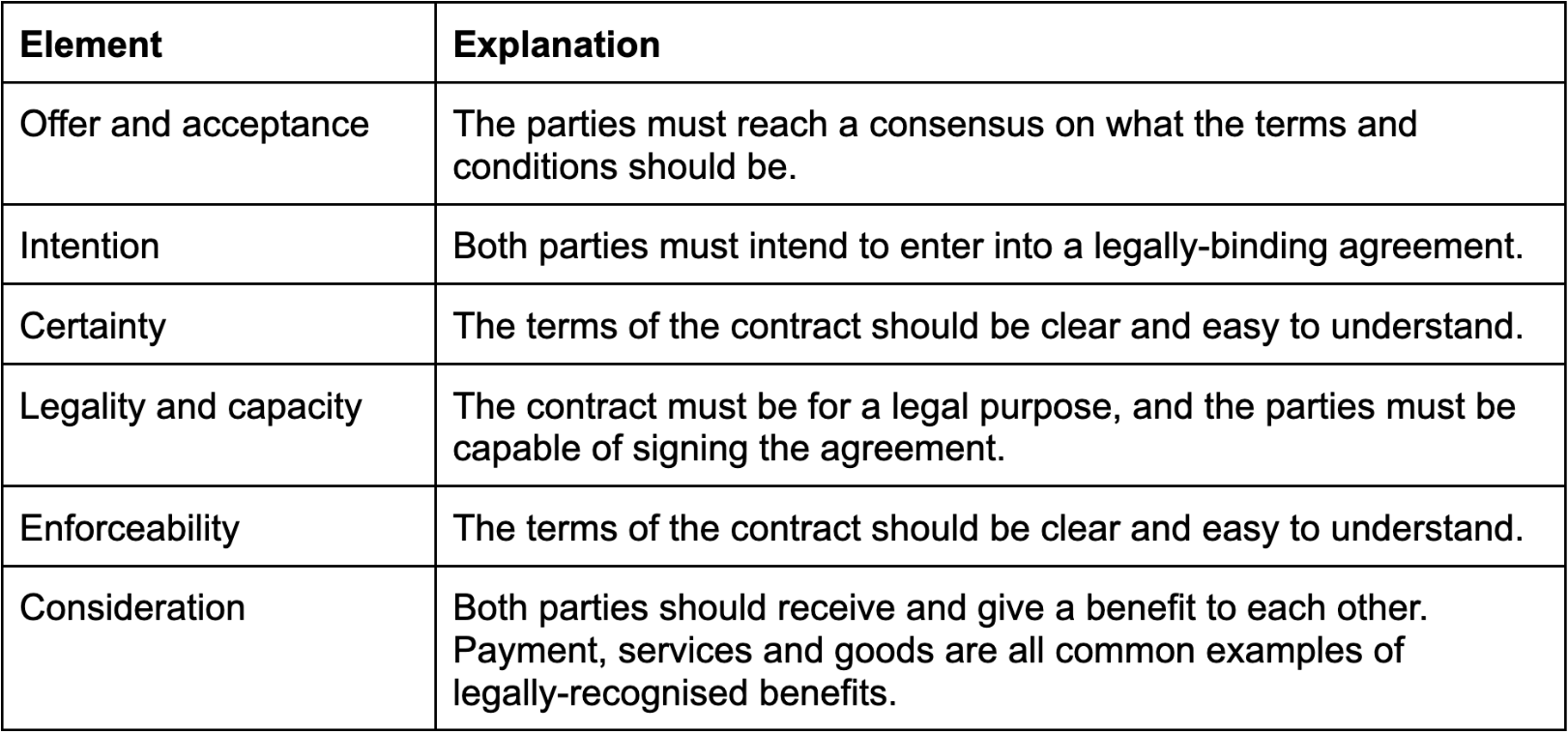
Example of a valid and enforceable contract
Polly hires Tom to work at her school, promising to pay him $10,000 a month. Three months have passed since the beginning of this work contract, and yet Tom has yet to receive a cent, so he files a case against Polly for breaching their contract.
Why Is this Contract enforceable?
- Offer and Acceptance: Polly offered the job and Tom accepted the terms and conditions
- Intention: Both intended to create a legally binding contract
- Legality and Capacity: The contract is for a legal purpose and the parties are legally capable of entering into the contract
- Consideration: Tom provides work and Polly promises payment of $10,000 per month
- Certainty: The terms and conditions are clear and certain
Tom performed his obligations while Polly failed to pay for the services. Hence, Tom can legally enforce the contract and seek remedies for breach of contract.
Example of an Unenforceable Agreement
Alex agrees to sell his paintings to Benjamin, and they both agree to come up with the purchase price and date of delivery later. Later, Alex changes his mind. “But we had an agreement!” Benjamin protests, and similarly brings the case to the court.
Why is this Agreement Unenforceable?
This contract is unenforceable because the essential terms like price and delivery were never agreed by the parties. The contract lacks certainty and will not be enforceable.
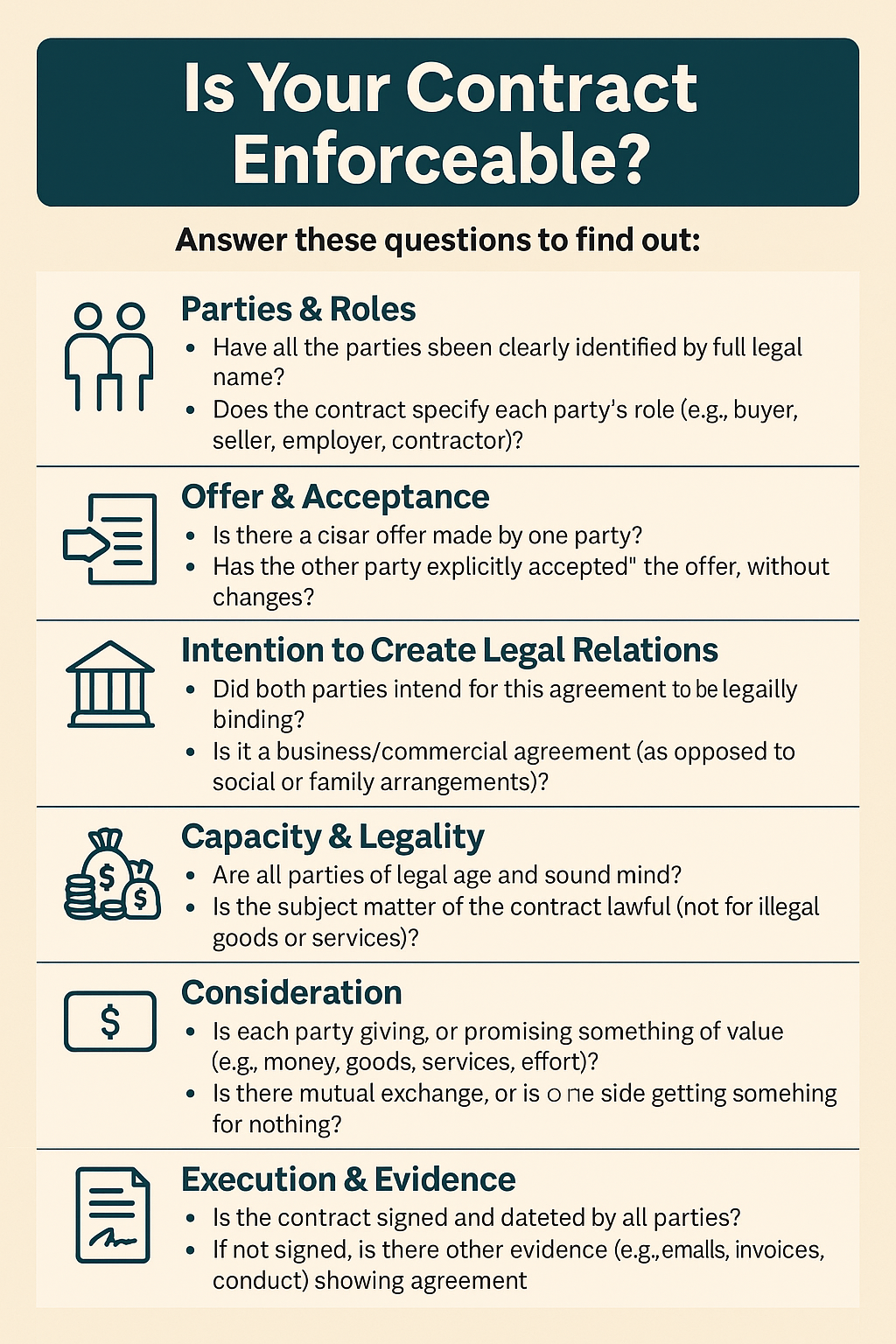
Benefits of an Enforceable Contract
There are multiple benefits to having your contract be enforceable in court.
- Safeguards your legal rights. You will only be able to sue in a court of law, or get compensation for a breached contract, if the contract itself is enforceable.
- it provides a useful set of guidelines for both parties’ decisions and actions. After all, a contract is a list of requirements and obligations. By having everything spelled out clearly, you minimise the chance for misunderstandings, so that everyone can work within their assigned role more efficiently.
Contract Review Checklist: Ask these Questions before You Sign A Contract:
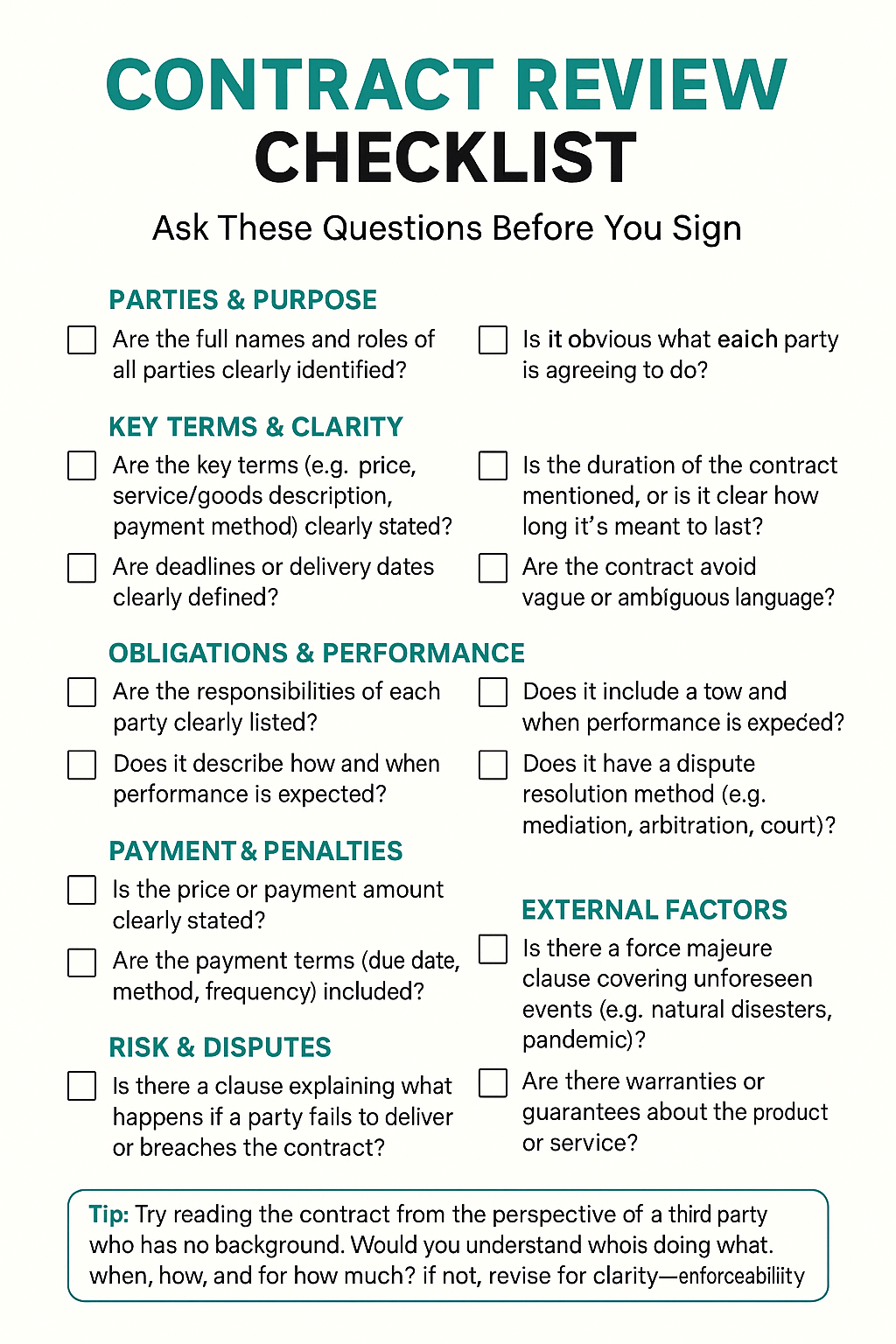
- Duration: Clearly state the term of the contract
This is the length of your contract. Some contracts (e.g.: sale of goods) will be a one-off exchange on a specific date. If your contract lasts for a stipulated duration, you should clearly write down the period, as well as the start and end dates.
- Example: If you’re writing an employment contract, you should clearly state the start and end times. If there are breaks, including a lunch break, you should state their lengths.
- Price: The price amount, or the mechanism for determining the price (e.g.: based on market conditions at a specified later time, which is common for contracts between manufacturers) should be listed out.
- Payment Terms: You should write out the specified payment date or deadline, whichever is applicable. You can also add requirements for how it should be paid (e.g.: bank transfer, cash, cheque). If the payment is in installments, you will need to specify how frequent the payments are.
- Penalties for Late Payment: To ensure the parties comply, you may impose penalties. I.e.: if A fails to make payments to B on time, B might have the right to withhold services. Or, they might be able to impose a late fee, increase the interest rate, or withdraw from the contract entirely. In contracts involving large transactions, B might be able to rely on A’s mortgage, if they fail to pay their dues. Adding such a clause is completely up to the parties, as long as they agree on the penalties and what situations would incur them.
- Obligations of the parties: These are the essential terms of the contract. You should describe the actions or services that are being rendered, or the goods that are being exchanged. Clearly describe what each party will be doing with enough detail (e.g.: the Vendor agrees to develop a custom software programme for the Company’s accounting activities, which shall contain the following features …)
- Detailed Timeframes: To better guide the process, there should be clear deadlines for performance, delivery, and completion. There could also be a hardship clause where party A can seek an extension of the deadline, after giving a set number of days’ notice.
- Warranties and Representations: These are promises about the condition of the goods or services. A seller might warrant that the goods are of merchantable quality, or suited for the purpose that the buyer wants them for. The same buyer might also represent (i.e.: declare) that the goods were made according to certain specifications, or handcrafted, or manufactured in a certain year.
- Force Majeure Clause: This is a clause detailing what will happen in the case of an unexpected event that majorly affects the performance of the contract. Imagine, for example, that company A purchases one million machinery parts from B, and immediately afterwards, the global price of iron unexpectedly surges. This might require significant changes to the contract, such as a complete recalibration of the purchase price, and modifying the performance deadline. As such, a force majeure clause will protect the rights of the parties in the case of a legitimate unforeseeable event, and prevent them from incurring penalties.
Final Thoughts
Still unsure about the contract drafting process? You can always start working from a template, and modify it as you go. DocLegal.AI creates customized legal documents in just a few clicks.
This includes tailor-made business agreements, general employment contracts, sales contracts, non-disclosure agreements, and more! Sign up now to enjoy 50% off your first subscription, and learn how you can simplify your day-to-day commercial and legal tasks.

Top 3 Most Common AI Contract Customizations: ChatGPT vs. DocLegal.ai
Compare AI contract tools: ChatGPT needs legal know-how; DocLegal.ai offers lawyer-trained, customizable templates for $1.
Top 3 Most Common AI Contract Customizations: ChatGPT vs. DocLegal.ai (We Tested Both)
As a legal professional, I use ChatGPT every day for brainstorming. But using it to generate binding contracts is a different story.
So, I ran an experiment.
First, I asked ChatGPT: "What are the top 3 most common contract customizations requested by users?"
It gave me this list:
- Payment Terms
- Termination Clause
- Limitation of Liability Clause
Then, I put both AIs to the test. I asked ChatGPT to write these clauses for a standard Consulting Agreement, and compared the results against a $1 DocLegal.ai template.
Here is exactly what happened.
The Verdict : General AI vs. Legal AI
If you are asking 'Is ChatGPT safe for contracts?', here is the summary of our findings:
Test 1 - Payment Terms
We asked for a monthly payment clause for a $100/hr consultant
Analysis for the Payment Terms:
Key takeaway of Test 1:
ChatGPT gives you a starting point for the payment provisions, however, you will need to provide further details to ensure it protects your interest as a client or consultant.
Test 2 - Termination Clause
We asked for a mutual termination clause between the client and consultant
Analysis for Termination Clause:
Key Takeaway for Test 2:
ChatGPTmisses critical post-termination safeguards like the return of company property and ongoing confidentiality rules leaving you to manually close these loopholes to protect your business assets.
Test 3: Limitation of Liability Clause
We asked both platforms to protect the Consultant from lawsuits.
Analysis for Liability Clause
Key Takeaway for Liability Clause
ChatGPT is acting like a robotic lawyer that tries to win every single point. Doclegal.ai ensure the contract gets signed as the clause language is the industry standard balance.It shows you understand professional norms, making you look like a serious partner, not a risky freelancer.
Conclusion: Is "General AI" Worth the Risk?
I use ChatGPT every day to outline ideas. But for legal documents, "free" comes with a hidden cost: Risk.
- ChatGPT: Fast to generate text, but misses critical protections like debt recovery costs. You save $1 but risk losing the client or your IP.
- DocLegal.ai: Takes 2 minutes. You select the template, the AI pulls your profile, and the legal logic is balanced to get your contract signed today.
Free Consulting Agreement on Doclegal.ai
Free NDA Negotiation Playbook

How DocLegal.AI Keeps Your Data Secure
Advanced encryption, secure cloud storage, and strict access controls keep your data safe with zero retention by third-party LLMs.
How DocLegal.AI Keeps Your Data Secure
At DocLegal.AI, we understand that the security of your data is paramount. As such, we employ industry-standard measures to protect your data. Here’s an overview of our data security practices, including how we handle data retention, storage, and ongoing monitoring.
GenAI Use and Commitment to Data Privacy and Security
- Separation of Data: We keep our documents and customer database separate from third-party LLMs used, ensuring that customer data is protected.
- User Privacy: Your data is stored in a secure cloud database, segregated by user accounts. This guarantees that private and confidential information remains exclusive to you.
- No Data Usage for Training: We do not use private and confidential information including user conversations to train third-party LLMs.
- Transparency: We encourage users to review our Privacy Policy and Terms of Service to understand how your information is collected, used, and stored.
Data Retention by Third-Party LLMs
Third-party LLMs used at DocLegal.AI adopt a zero data retention policy, where personal data from API requests are not retained.
Data Storage and Processing
Your data is securely stored in a cloud-based SQL database designed for high security and reliability. Additionally, we use a specialized vector database for efficient document searching. This dual-layer approach ensures that your data remains both accessible and secure.
Trusted Collaborations
We partner with highly secure and certified service providers who meet rigorous industry standards, ensuring your data is handled with the utmost care.
Database Security Measures
We implement several safeguards to protect our databases from unauthorized access, including:
- IP Blocking: Restricting access to recognized IP addresses.
- Access Controls: Utilizing a Relational Database Management System (RDBMS) for managing permissions.
- Secure Credential Storage: Keeping sensitive information encrypted and secure.
Proactive Vulnerability Monitoring
We actively monitor our systems for vulnerabilities using advanced tools to identify and mitigate risks, ensuring continuous operational integrity.
Encryption Standards
To protect your data, we implement strict encryption standards:
- Data in Transit: All communications are secured using HTTPS protocols.
- Password Security: Customer account passwords are encrypted, making them inaccessible to unauthorized users.
Third-Party Integration Compliance
We strive to ensure that third-party integrations comply with our security protocols for data transfer. Compliance largely depends on the policies of the third-party services we utilize.
Authentication
For your protection, our policy regarding account lockouts is straightforward: after three failed login attempts, you will be prompted to "try again later." This measure helps prevent unauthorized access.

What If Your Next Contract Cost Only $1?
Learn how DocLegal.ai’s AI legal tools generate startup contracts for $1, saving thousands on NDAs, shareholder agreements, and more with lawyer-approved templates.
What If Your Next Contract Cost Only $1?
Starting a new business or scaling your existing one, contracts are the bread and butter of your operations. But this essential foundation requires a considerable budget.
What Legal Documents Does A Startup Need?
With 10 years of experience in drafting contracts for startups and growing companies, I know the drill . My clients when starting a business often request bundles comprising of:
- Non-Disclosure Agreement
- Licensing Agreement
- Shareholder Agreement,
- Employment contracts, and
- HR Policy Manual
The cost for such a starter pack for legal templates can exceed $1000 - $2500+depending on the complexity in customization and negotiation support requested. With the advent of AI, clients are now using AI legal generators for these templates
How Much Can You Save with an AI Legal Generator?
Legal AI Tools can now generate this starter pack and customize based on your requirements at 1$ per document only!
Let me show you how this stacks up in numbers:

That’s less than the cost of your weekly coffee budget, and this takes 5 minutes and no back and forth exchange of emails with a lawyer.
Which is the Best AI Legal Generator?
While there are many legal AI tools in the market, I highly recommend DocLegal.ai as this platform is trained on templates approved by lawyers and is not just another generic AI tool.
What is Doclegal.ai? How does it work?
Doclegal.ai is the only AI Legal Tool For Small Business.
No Legal experience needed
AI Legal Tools are revolutionizing access to legal templates without compromising on quality.
But here’s the catch: Most of the AI legal tools online target legal professionals, not business owners.
Doclegal.ai is changing this. Doclegal.ai is an AI legal tool for small business. This AI Legal generator is designed for entrepreneurs, small business owners and no legal background is required. With plain language prompts, anyone can generate legal templates AI within minutes for less than the price of coffee! Watch out tutorial on how to generate documents within the DocLegal.AI.
Here’s what you get with DocLegal.ai:
- Access to Contract library of 2800+ legal templates.
Doclegal.ai, AI legal generator, gives you instant access to an extensive library of contract templates. Type the name of the contract you need and it will generate a lawyer approved template for you
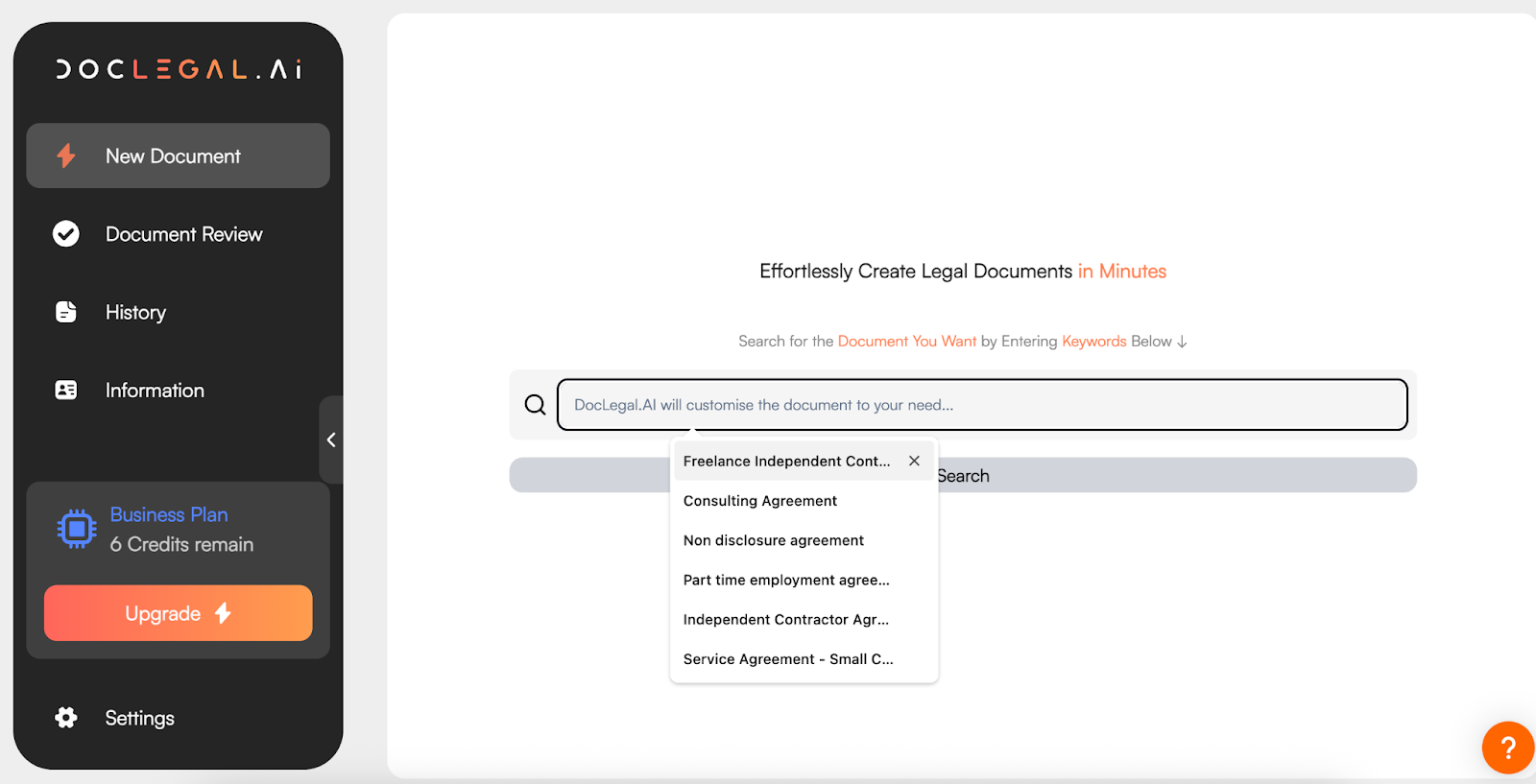
- AI Customization
AI customizes these templates based on your plain language prompt.
Example: Just ask AI to:
- include a late payment penalty clause,
- add early termination fees payable by party A, and
- make the one-sided indemnity clause mutual”
Doclegal.ai Chatbot will insert the language automatically in the template and your template will be ready for your client’s review and signature within minutes.
- Instant Download in Word/PDF Form
Download and Ready to send or sign
- AI Contract Review
Upload your contracts for AI Contract Review. It will do an instant risk analysis, replace party names where needed, provide clause languages based on your prompt, and let you edit the document - all in one place. This is your 24/7 paralegal on demand
DocLegal.ai is your 24/7 assistant on demand!
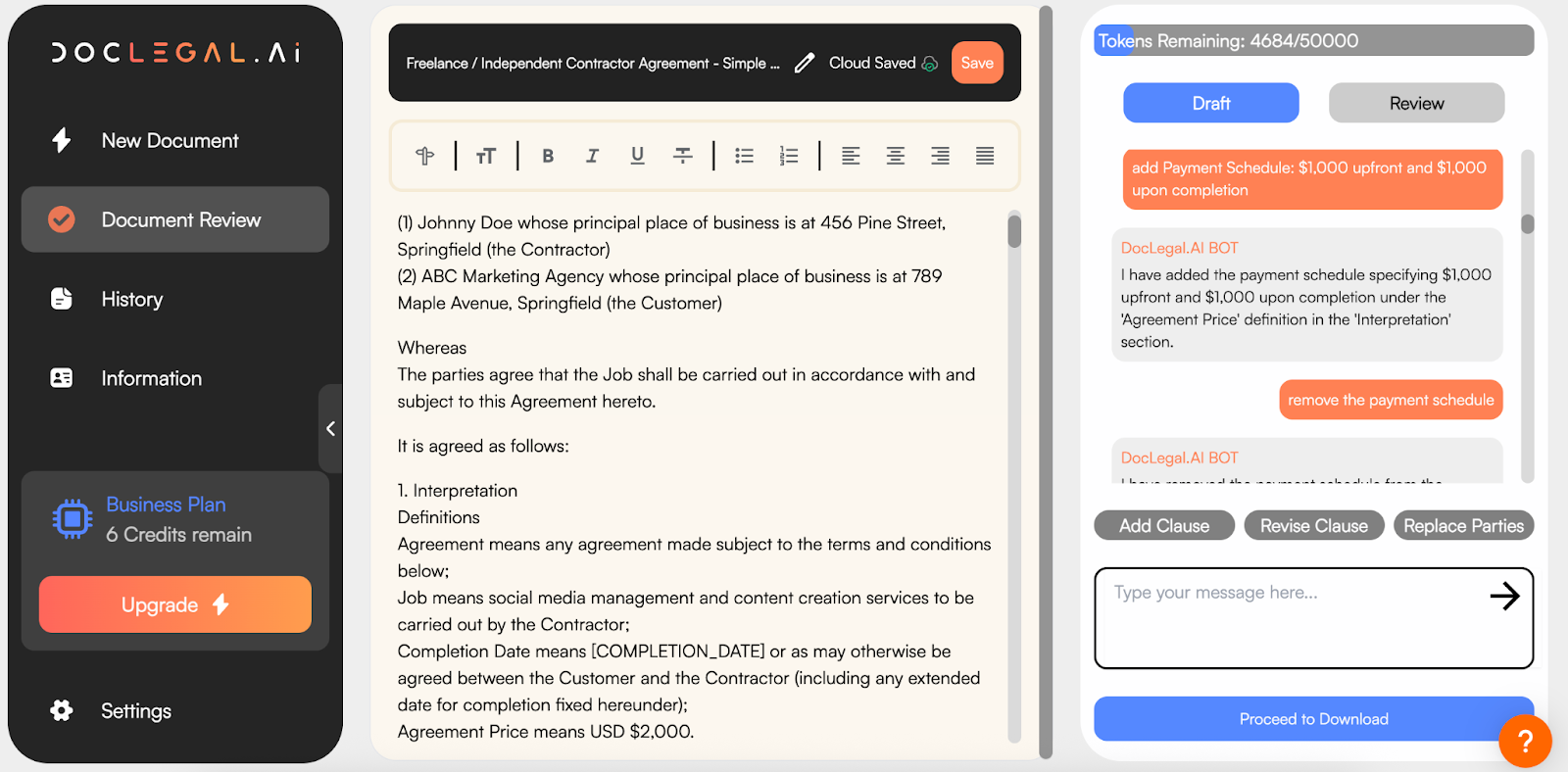
Are AI Generated Legal Templates Reliable?
Yes, when created by trusted platforms like DocLegal.ai, AI-generated legal templates can be highly reliable. DocLegal.ai's chatbot is trained using templates developed and reviewed by legal professionals, ensuring accuracy and practical usability.
ChatGPT is Free, are AI Generated Legal Templates by ChatGPT reliable?
ChatGPT can help speed up your daily tasks and provide a basic contract template. However, these templates are not contract-ready and require significant legal edits before use.
While ChatGPT can give lawyers a useful starting point, the drafts are not suitable for immediate use or signing by business owners.
We have compared DocLegal.ai with other AI tools. Doclegal.ai is AI for legal documents and the templates are ready for immediate use. It is easy to use and does not require any legal expertise from the user.
What do customers say about DocLegal.ai?
DocLegal rocks.
“It took my document and really made it real. It was so fast I am amazed. Thanks guys.”
— JuliusSchenck
“Safe buy.”
“I bought the program and I’ve kicked the tires on it a bit, and it really is a solid program. At least for quick drawn up deals.”
— algivens74
Ready to Save on Your Next Contract?
Try DocLegal.ai today and experience affordable, fast, and reliable legal document generation.

NDAs for Freelancers: Protecting Your Ideas in the Gig Economy
Master NDAs to protect your freelance ideas in the gig economy. Learn essential components and use DocLegal.AI for affordable, tailored agreements.
NDAs for Freelancers: Protecting Your Ideas in the Gig Economy
As a freelancer, your creativity is your currency. Whether you're a consultant pitching a campaign, a designer crafting a brand’s identity, or a writer shaping a startup’s narrative, your ideas deserve protection. A Non-Disclosure Agreement (NDA) safeguards your intellectual property and ensures clients respect your ideas. This guide explains why NDAs are vital for freelancers, their key components, and how to create one yourself.
What Is an NDA and Why Do Freelancers Need One?
An NDA is a legal contract that prevents a client from sharing your confidential information without permission. In the gig economy, where freelancers collaborate with startups, brands, or other creatives, NDAs are essential to protect shared ideas. For example, an online influencer pitching a unique social media campaign risks idea theft without an NDA. By securing one, they can pitch confidently, knowing their concept is protected. DocLegal.AI’s AI legal document generator simplifies the process, letting you create tailored NDAs without needing a law degree or a big budget.
Which Freelancers Might Want an NDA
Freelancers in various fields should consider using an NDA to protect their creative and intellectual work. Here are key fields where an NDA is particularly valuable:
- Design: Graphic designers, UX/UI designers, or product designers often share original mockups, prototypes, or branding concepts that need protection from unauthorised use or sharing.
- Content Creation: Writers and videographers writing scripts, creating social media campaigns or blog strategies risk clients repurposing their ideas without credit or payment.
- Marketing and Advertising: Freelancers pitching unique campaign ideas, marketing strategies, or advertisement ideas need NDAs to prevent clients from implementing these without payment.
- Technology and Development: Software developers, app creators, or IT consultants pitching tech solutions require NDAs to safeguard proprietary work.
- Consulting: Business strategists, financial consultants, or startup advisors sharing innovative plans or trade secrets need NDAs to ensure confidentiality.
- Creative Arts: Photographers, illustrators, or musicians sharing unreleased work, such as photoshoot concepts or original compositions, benefit from NDAs to maintain creative control.
Key Components of a Freelancer NDA
A well-crafted NDA protects your work while maintaining a professional client relationship. Here are the essential elements every freelancer NDA should include.
1. Definition of Confidential Information
Clearly define what qualifies as “confidential” to ensure both parties understand what’s protected.
- What to include: Specify information types, such as campaign concepts, design mockups, or business strategies. Be clear but broad to cover all important material.
2. Duration of Confidentiality
Specify how long the confidentiality obligation lasts, tailored to your project and industry norms.
- What to include: Common durations are one to five years post-project, though sometimes trade secrets may require indefinite protection. For example, a photographer’s NDA might require his client to keep a photoshoot concept confidential for two years, so that he may reuse the idea for other projects without competition.
3. Exceptions to Confidentiality
Some information isn’t protected, such as publicly available data or previously shared ideas.
- What to include: List exceptions, e.g., information already known to the client, publicly available, or legally required to be shared.
4. Remedies for Breach
Stipulate consequences for NDA violations, including breaches by the client’s affiliates, to ensure accountability.
- What to include: Specify that breaches, including those by affiliates (e.g., subcontractors or employees), may lead to damages for lost opportunities or an injunction to stop misuse. Holding clients liable for affiliates’ breaches strengthens protection.
Why NDAs Are Critical for Young Creatives
For millennials and Gen Z freelancers, the gig economy offers opportunities but also risks. Every pitch you make is built on trust. An NDA helps make that trust mutual, not just assumed. Without an NDA, you’re vulnerable to idea theft, which can harm your reputation and income. An NDA levels the playing field, letting you collaborate confidently while protecting your creative work.
Practical Tips for Using NDAs Effectively
- Discuss NDAs early: Raise the topic before sharing your proprietary ideas to set clear expectations and demonstrate professionalism.
- Customise for each project: Tailor your NDA to specific clients or gigs for relevance. The same information might be sensitive for one project, not the other.
- Keep records: Store signed NDAs securely and track shared information.
- Combine with contracts: Pair your NDA with a broader freelance agreement covering payment, scope, and other terms.
Real-World Example: Protecting Your Pitch
Imagine Alex, a 28-year-old influencer, pitching a video series to a tech startup with unique hashtags and content ideas. Without an NDA, the startup could use Alex’s concept internally or share it with another influencer. By using an NDA, Alex defines the pitch as confidential and restricts its use to the agreed project. If the startup shares it with a competitor, Alex can sue for damages, protecting his work and reputation.
FAQ: NDAs for Freelancers
1. Are there different types of NDAs?
Yes, NDAs can vary based on purpose and scope. Common types include unilateral NDAs (one party shares confidential information), bilateral NDAs (both parties share sensitive information), and multilateral NDAs (multiple parties are involved). Freelancers typically use unilateral NDAs to protect their ideas when pitching or collaborating with clients.
2. When should I ask a client to sign an NDA?
You should discuss and have an NDA signed before sharing sensitive information, such as during the pitching phase or at the start of a project. This sets clear expectations and protects your ideas from being misused.
3. Can I use the same NDA for every freelance project?
While a template is a good starting point, it’s best to customise your NDA for each project or client to address specific needs, such as the type of confidential information or project duration, to ensure maximum protection.
4. What happens if a client breaches an NDA?
If a client violates an NDA, you may seek remedies like financial damages for lost opportunities or an injunction to stop further misuse. The NDA should outline these consequences, including liability for breaches by the client’s affiliates.
5. How can DocLegal.AI help me create an NDA?
DocLegal.AI offers an AI-powered tool to generate tailored NDAs quickly and affordably, without requiring legal expertise. It helps freelancers create professional contracts to protect their ideas and focus on their work.
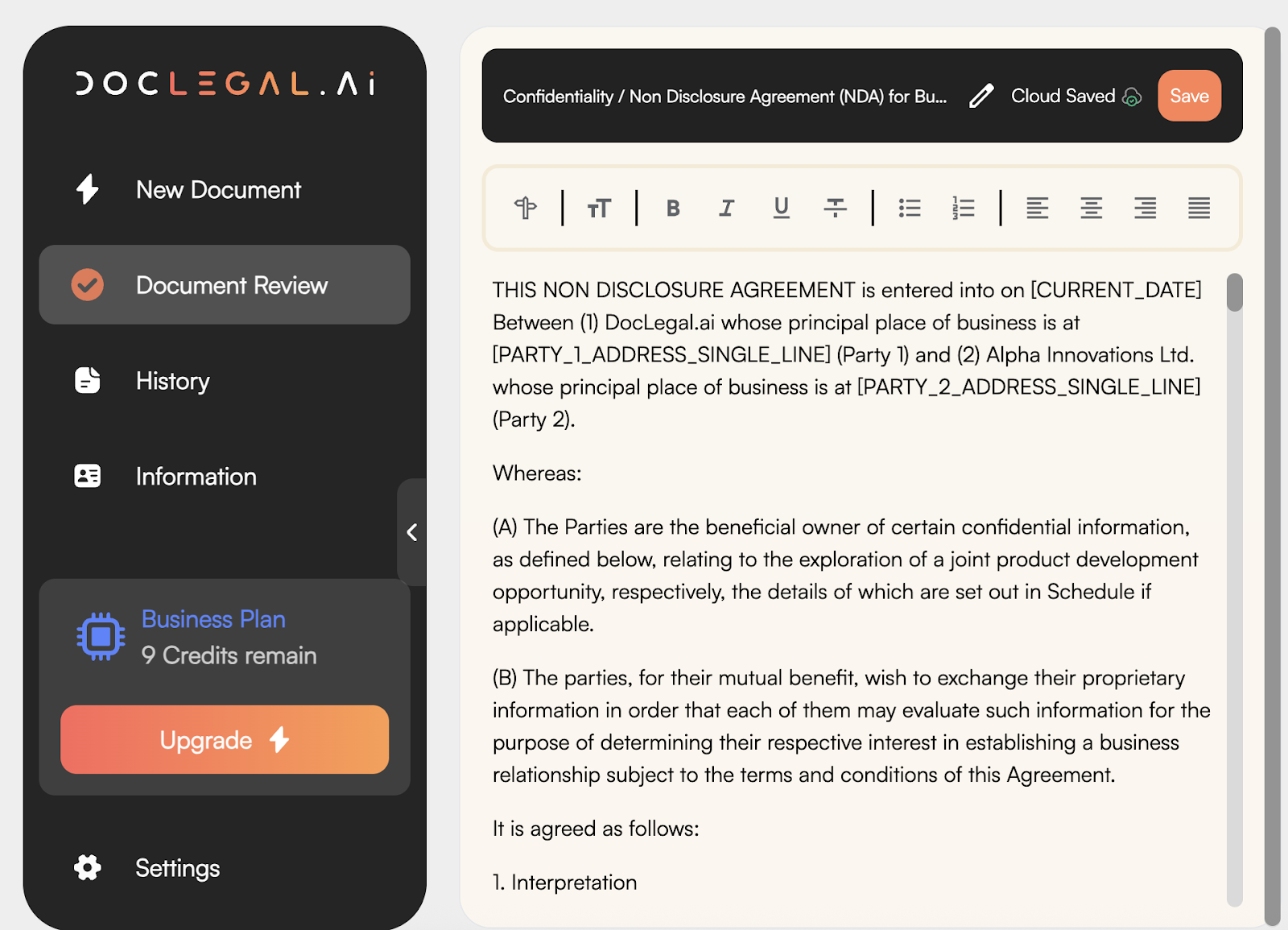
Get Started with DocLegal.AI Today
In the fast-paced gig economy, your ideas are your greatest asset. An NDA ensures they remain yours, empowering you to collaborate with confidence. DocLegal.AI makes creating professional, tailored NDAs affordable, helping young creatives protect their work and focus on building their brand. Visit us now to generate your first contract and start protecting your freelance business with confidence!

How to Draft Freelancer Contracts for Gig Economy Workers
Master drafting freelancer contracts for gig economy workers with AI tools. Protect your work, secure payments, and avoid disputes with clear, legally sound agreements.
How to Draft Freelancer Contracts for Gig Economy Workers
The gig economy is booming, but with freedom comes the risks. Whether you are designing social media content, writing copy, or developing websites. As a one-man band you are designing social media content, writing copy, or developing websites. All these tasks are being done without a full legal team’s support. Hence, a well-crafted freelancer contract can be your safety net. A lawyer approved freelancer contract will offer you legal protection without the scary lawyer fees. In this guide, we’ll walk you through how to prepare a comprehensive freelancer contract.
Why Freelancers Need Freelancer Contracts
Imagine this: You just landed a gig creating logos for a startup on some forum. After countless hours of hard work, you send over your work, but then the client ghosts you when it’s time to pay. Or worse, they start using your designs in ways you never agreed to. These gig economy legal issues are all too common, but a solid contract can definitely prevent them.
A freelancer contract isn’t just a formality, it’s a legal tool that sets clear expectations for both you and your client. It outlines what you’ll do, when they’ll pay, and who owns the work. If you are a young entrepreneur or someone who has just started their side hustle, creating contracts with AI tools like DocLegal.AI ensures your contracts are professional, legally enforceable, and tailored to your needs, without the hefty price tag of a lawyer.
What contracts do you need?
Here are the most commonly used freelancer contracts on our platform:
- For writing-related roles, e.g., copywriting, blog & article writing, email marketing, social media content, academic writing, etc, our Freelance Writer Agreement is tailored to meet your needs.
- For creative and technical professionals, such as web designers or software developers, we recommend the Web Designing Agreement or the Software Development Agreement to define project scope and deliverables.
- After you have delivered your work, use our Freelance Invoice to bill clients clearly and professionally.
- Want to be more flexible? Try our Independent Contractor Agreement and customise it with just a few prompts to suit any freelance arrangement.
Key Elements of a Freelancer Contract
Let’s dive into the essential components of a freelancer contract. These elements protect your work, define responsibilities, and prevent disputes. DocLegal.AI includes all these at the click of a button, making well-drafted contracts accessible to everyone without prior experience in legal drafting.
1. Scope of Work: Define What You’re Providing
The scope of work is the crux of your contract. It spells out exactly what you’ll provide, so there’s no room for confusion. Be as specific as you can, vague terms often lead to misunderstandings and are a breeding ground for disputes.
- What to include: List deliverables (e.g., “three one-minute Instagram Reels” or “a 1,000-word blog post”), deadlines, and any specific requirements (e.g., file formats or revisions).
- Example: “The contractor shall complete the Job by the Completion Date, delivering three (3) original blog posts of more than 1,000 words each. Topics, keywords, and tone will be determined and approved by the Customer prior to commencement. Each post must be delivered in Word format, include relevant headings and metadata, and be optimised for SEO as per the Customer's content guidelines. The Contractor shall provide up to three rounds of revisions per article within five business days of each draft submission, addressing specific feedback provided by the Customer.”
2. Payment Terms: Get Paid Fully and On Time
Money is a top concern for freelancers, and clear payment terms are non-negotiable. A payment clause should outline how much you’ll be paid, when, and how.
- What to include:
- Total fee or hourly rate.
- Payment schedule (e.g., 50% upfront, 50% upon completion).
- Payment method (e.g., PayPal, bank transfer).
- Late payment penalties (e.g., 5% fee for payments over 30 days late).
- Example: “The Customer shall pay the Agreement Price of USD 200 to the Contractor in two instalments: 50% (USD 100) upon signing this agreement, and 50% (USD 100) upon completion of the Job. Payment shall be made by bank transfer to the account details provided by the Contractor.
The Contractor will invoice the Customer for each instalment. The invoice will include all services performed under this Agreement as well as any expenses, if applicable.
Payment will be due upon receipt of the invoice. A late charge of 5% per month on the outstanding amount will be added to any invoice not paid within 30 days of the invoice date.”
3. Intellectual Property (IP) Rights: Protect Your Creations
As a freelancer, your work is your brand. Intellectual property clauses define ownership rights of your work and how it can be used. This is particularly important for creatives and artists.
- What to include:
- Specify whether you’re transferring ownership of your work or granting a license (e.g., the client can use your work for marketing but can’t resell it).
- Clarify usage rights (e.g., purpose, duration, or specific platforms).
- Optional: include a clause protecting your right to showcase the work in your portfolio.
- Example: “The Designer shall retain all Intellectual Property Rights, including copyright, in any and all works, materials, designs, concepts, and deliverables created in the course of providing the Services under this Agreement.
The Designer hereby grants to the Customer a non-exclusive, non-transferable licence to use the deliverables solely for the purposes expressly set out in this Agreement. The Customer shall not reproduce, modify, adapt, or exploit the deliverables for any other purpose without the prior written consent of the Designer.”
4. Termination Clause: Prepare for the Worst
Sometimes, gigs don’t work out. A termination clause outlines how either party can end the contract and what happens afterwards.
- What to include:
- Conditions for termination (e.g., failure to pay, breach of contract).
- Notice period (e.g., 7 days’ written notice).
- Payment for work completed before termination.
- Example: “Either party may terminate this Agreement by giving the other party not less than seven (7) days' written notice in the event of a material breach of this Agreement by the other party, provided that the breach is not remedied within such notice period.”
5. Confidentiality and Non-Disclosure: Safeguard Sensitive Information
If you’re working with sensitive client information or sharing proprietary ideas, a confidentiality clause is essential for safeguarding both you and your client.
- What to include:
- Define what information is confidential (e.g., client’s marketing plans).
- Specify how long confidentiality lasts (e.g., one year after the project ends).
- Example: “Each party undertakes that it shall not at any time during this Agreement, and for a period of one (1) year after termination or expiry of this Agreement, disclose to any person any confidential information concerning the business, affairs, customers, clients or suppliers of the other party, except as permitted by this clause.”
6. Dispute Resolution: Handle Conflicts Professionally
Disputes happen, but a contract can outline how to resolve them without escalating to costly legal battles.
- What to include:
- Specify a process, like mediation or arbitration, before legal action.
- Indicate which state’s laws apply (if necessary).
- Example: “Any dispute or difference, whether contractual or non-contractual, arising out of or in connection with this contract, including any question regarding its existence, validity or termination, shall be referred to and finally resolved by arbitration under the [Arbitration Rules] in force when the notice of arbitration is received by the other party or parties, which rules are deemed to be incorporated by reference in this clause.”
How DocLegal.AI Simplifies the Process
Drafting a contract from scratch can feel overwhelming, especially if you’re new to the gig economy. That’s where we come in. Our freelance agreement AI takes the guesswork out of creating contracts by:
- Guiding you through customisation: Answer a few guided questions about your project, and the platform generates a tailored contract.
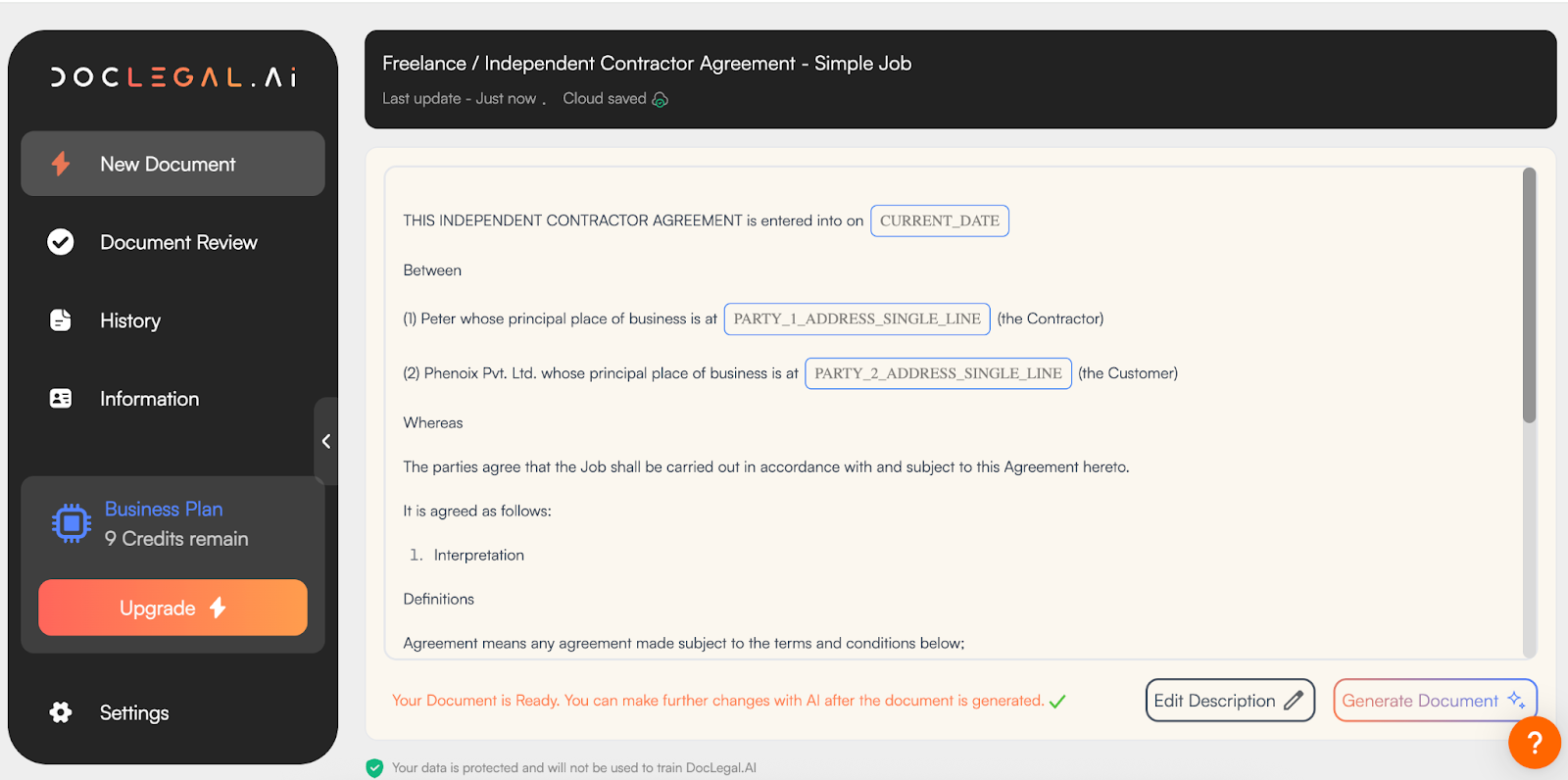
- Avoiding legal traps: Both freelancer-favouring and client-favouring contracts are available. Pick based on your position.
- Review Client Contracts with Doclegal.ai: You can upload the Client Contract on DocLegal.ai and get it AI reviewed, customized and downloaded.
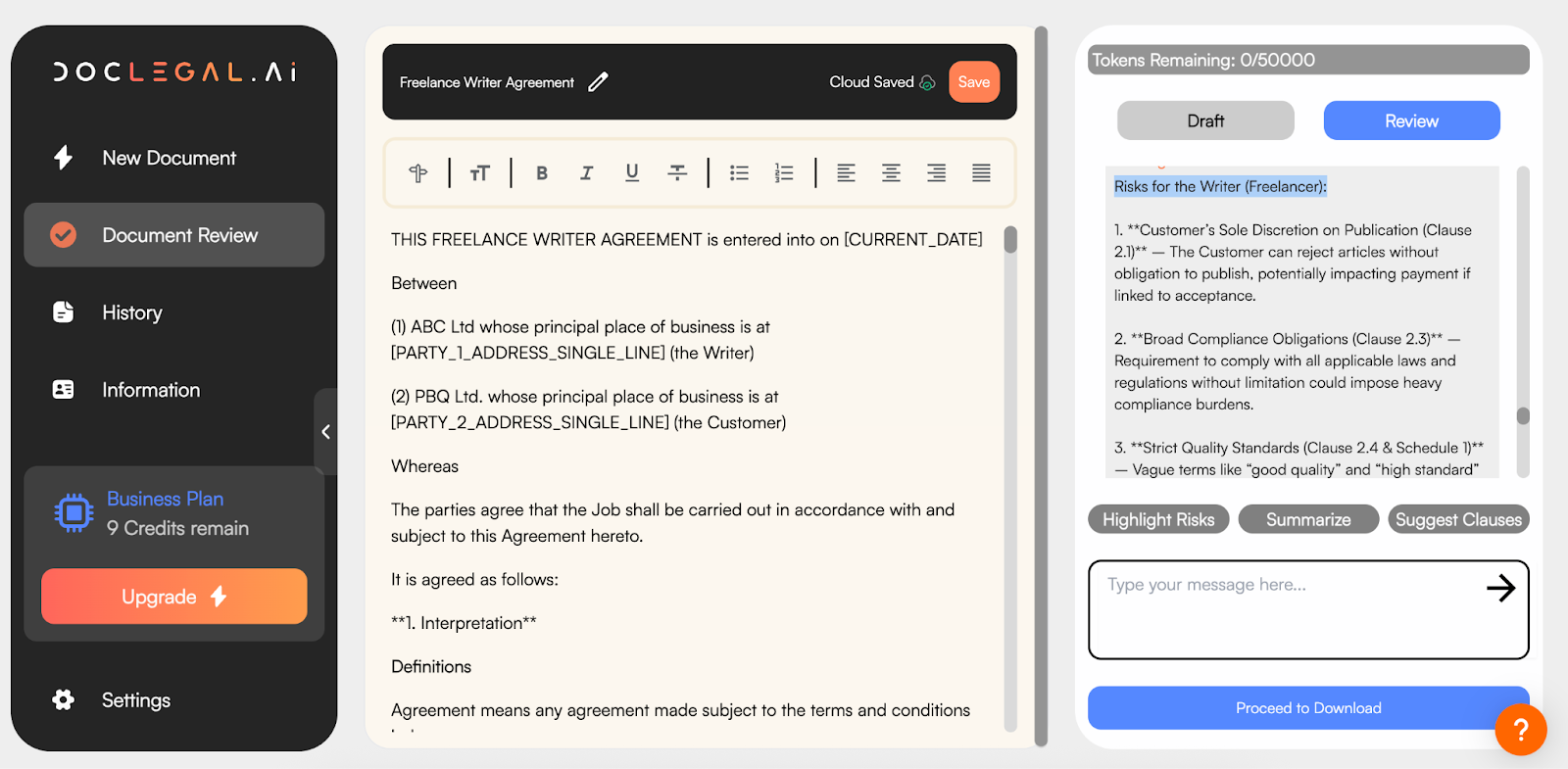
- Saving time and money: Say goodbye to substantial lawyer fees or countless hours researching legal terms.
Tips for Using Contracts Effectively
- Review before signing: Always read the contract carefully to ensure it reflects your true intention. A dispute over a single word is all it takes to start a million-dollar litigation.
- Communicate clearly with clients: Discuss contract terms upfront to avoid surprises.
- Keep records: Store signed contracts securely for reference in case of disputes.
- Update as needed: If your services or rates change, use DocLegal.AI to update your freelancer contract template accordingly.
Get Started with DocLegal.AI Today
Ready to take control of your freelance career? Our freelancer contract template makes it easy to create legally sound agreements in minutes. Whether you’re drafting side hustle contracts for influencer partnerships, design projects, or consulting gigs, we’ve got you covered. Visit us now to generate your first contract and start protecting your freelance business with confidence!



.jpg)